


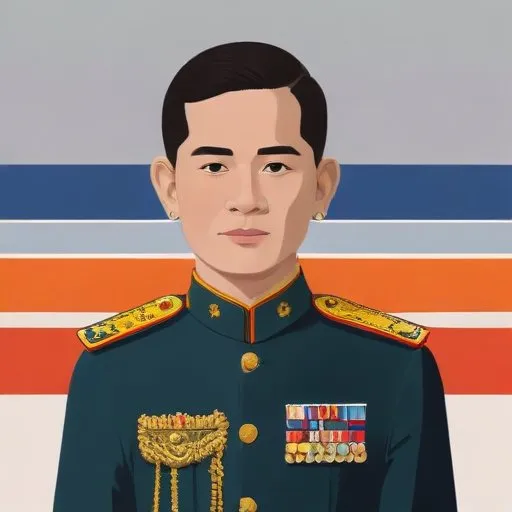
Leader who reunified Siam after a period of division and established Thonburi as the new capital, known for his military campaigns and efforts to modernize the country.
Taksin, the legendary King of Thonburi, is renowned for his unwavering leadership, which liberated Siam from Burmese occupation and unified the fractured kingdom, earning him the esteemed title of Maharaj The Great.
Born on April 17, 1734, Taksin rose from an aristocratic background in the Ayutthaya Kingdom to become a powerful leader, determined to free his people from the shackles of Burmese rule.
In 1767, Taksin joined forces with other Siamese leaders to drive out the Burmese invaders, who had ravaged the kingdom of Ayutthaya. This pivotal victory marked the beginning of Taksin's reign, which would last from 1767 to 1782.
Taksin's strategic prowess enabled him to unify Siam, as he subjugated various warlords and expanded his kingdom's borders. He established the city of Thonburi as the new capital, revitalizing the war-torn region and fostering economic growth.
Despite the numerous wars that characterized his reign, Taksin remained committed to promoting the arts, literature, and education. He encouraged the development of drama, painting, architecture, and handicrafts, restoring and renovating temples and promoting religious studies.
Taksin's administration was marked by progressive policies, including the construction of roads and canals, which facilitated trade and commerce. He also fostered diplomatic relations with foreign countries, ensuring Siam's position on the global stage.
In 1782, Taksin was overthrown in a coup d'état and executed, marking the end of his remarkable reign. His legacy, however, endured, as his friend Maha Ksatriyaseuk succeeded him, founding the Rattanakosin Kingdom and the Chakri dynasty, which continues to rule Thailand to this day.
Taksin's indomitable spirit and visionary leadership have earned him a revered place in Thai history. His unwavering commitment to his people and his country has inspired generations, cementing his status as one of the greatest leaders in Siamese history.
Taksin's reign marked a significant turning point in Thai history, as he successfully liberated Siam from Burmese occupation and unified the kingdom. His legacy continues to shape the country's identity and inform its leadership to this day.
Taksin's leadership style and vision for Siam can be compared to that of other great Asian leaders of his time, such as Emperor Qianlong of China and King Louis XV of France. Like them, Taksin demonstrated exceptional military prowess, administrative acumen, and cultural patronage.
In conclusion, Taksin the Great remains an iconic figure in Thai history, celebrated for his bravery, strategic genius, and dedication to his people. His enduring legacy continues to inspire Thais and people around the world, serving as a testament to the power of strong leadership and unwavering determination.
Born in 1737
Founded the Chakri dynasty, which still reigns in Thailand today, and unified the country after a period of turmoil, establishing a strong and stable government.
Born in 1737
Founded the Chakri dynasty, which still reigns in Thailand today, and unified the country after a period of turmoil, establishing a strong and stable government.
Born in 1737
Founded the Chakri dynasty, which still reigns in Thailand today, and unified the country after a period of turmoil, establishing a strong and stable government.
Born in 1737
Founded the Chakri dynasty, which still reigns in Thailand today, and unified the country after a period of turmoil, establishing a strong and stable government.
Born in 1737
Founded the Chakri dynasty, which still reigns in Thailand today, and unified the country after a period of turmoil, establishing a strong and stable government.
Born in 1737
Founded the Chakri dynasty, which still reigns in Thailand today, and unified the country after a period of turmoil, establishing a strong and stable government.
