


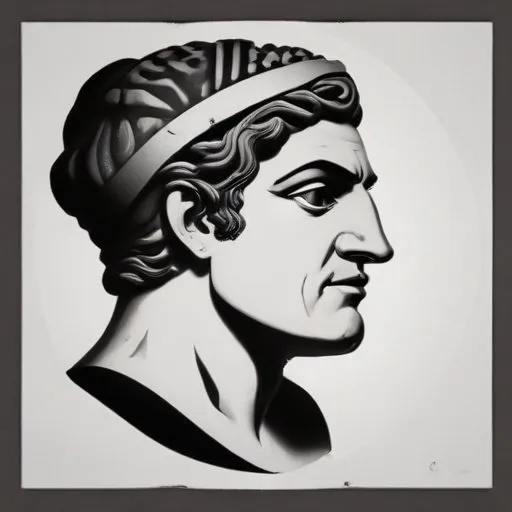
A pioneering Greek artist who mastered multiple mediums, creating intricate engravings, etchings, and sculptures that showcased his technical skill and artistic vision.
Tassos, born Anastasios Alevizos on March 25, 1914, is renowned for his profound and poignant engravings and sculptures that immortalize the significant milestones of 20th-century Greek history. His works, infused with passion and patriotism, have left an indelible mark on the art world, earning him the reputation as one of Greece's most prominent engravers.
Tassos was born in Lefkochora, Messenia, Greece, and demonstrated an early affinity for art. At the tender age of 16, he began studying at the School of High Arts in Athens (1933-1938), where he honed his skills in engraving under the guidance of esteemed artists, including Demetrios Galanis, Argyros, and Parthenis. His thirst for knowledge and artistic growth led him to continue his studies in Rome, Florence, and Paris.
Tassos's talent was soon recognized, and he received the prestigious Prize of Engraving in 1938, followed by the State Medal of Engraving in 1940. These awards not only validated his skills but also propelled him to greater heights, solidifying his position as a respected artist in Greece.
Tassos's art was deeply influenced by his strong political convictions and empathy for the struggles of the common people. As a member of the communist left party since 1930, he actively participated in the United Panhellenic Organization of Youth (EPON) and the National Liberation Front (EAM) during the occupation. During the 7-year dictatorship (1964-1973), Tassos chose self-exile, a testament to his unwavering commitment to his ideals.
Tassos drew inspiration from the struggles of his nation, the breathtaking natural beauty of Greece, and the everyday lives of ordinary people. This diverse range of influences resulted in a unique and captivating style that resonated with audiences worldwide.
One of Tassos's most notable works is his depiction of the 1942 Gorgopotamos railway station episode, a poignant representation of Greek resistance during World War II. His art has been exhibited in prominent institutions, including the National Gallery in Athens (1976), and he has participated in prestigious international events, such as the Venice Biennale exhibition in 1952. Tassos's works have also been showcased in the USA, Soviet Union, France, Italy, and Japan, solidifying his reputation as a master engraver and sculptor.
Tassos's contributions to Greek art and culture are immeasurable. He has left an indelible mark on the art world, inspiring generations of artists and cementing his position as one of Greece's most important representatives of engraving and sculpture. His art continues to captivate audiences, serving as a testament to his unwavering dedication to his craft and his country.
From 1962 until his passing in 1985, Tassos designed stamps for the Republic of Cyprus, leaving a lasting legacy in the world of philately.
Tassos's life was a testament to his passion, creativity, and commitment to his craft. As we reflect on his remarkable journey, we are reminded of the power of art to inspire, educate, and transcend borders. Tassos's legacy continues to inspire and captivate audiences, ensuring his place in the annals of Greek art history.
Born in 1888
A pioneer of Surrealist art, creating dreamlike, eerie, and thought-provoking scenes that blend reality and fantasy, influencing generations of artists and filmmakers.
Born in 1890
A 20th-century master of still-life painting, capturing the essence of everyday objects in subtle, nuanced colors and compositions. His work continues to inspire artists and designers alike.
Born in 1881
A pioneering artist who transformed modern art with pioneering Cubist works, creating a new visual language that continues to inspire and influence art, design, and culture.
Born in 1869
A pioneering artist who revolutionized modern art with bold, expressive, and colorful works that blurred the lines between painting and sculpture, creating a new language of form and color.
Born in 1904
A renowned surrealist master of bizarre, dream-like paintings and sculptures that blur reality and fantasy, known for iconic works like "The Persistence of Memory" and "The Elephants".
