


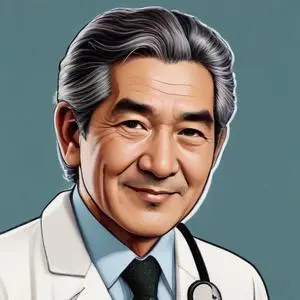
A Japanese immunologist who discovered the programmed cell death protein, PD-1, and its role in cancer therapy, leading to the development of cancer immunotherapy treatments.
Tasuku Honjo is renowned for his groundbreaking discovery of programmed cell death protein 1 (PD-1), a crucial immune checkpoint that has revolutionized cancer treatment. Additionally, his molecular identification of cytokines IL-4 and IL-5, as well as the discovery of activation-induced cytidine deaminase (AID), have significantly advanced our understanding of the immune system.
Honjo was born on January 27, 1942, in Kyoto, Japan. He pursued his academic interests at Kyoto University, where he earned his M.D. degree in 1966 and Ph.D. degree in Medical Chemistry in 1975 under the supervision of Yasutomi Nishizuka and Osamu Hayaishi.
Honjo's academic career is marked by a series of prestigious appointments, including his time as a visiting fellow at the Department of Embryology at Carnegie Institution of Washington (1971-1973) and a fellow at the U.S. National Institutes of Health (NIH) in Bethesda, Maryland (1973-1977). He later became an NIH Fogarty Scholar in Residence, starting in 1992.
Throughout his career, Honjo has held professorial positions at various esteemed institutions, including the University of Tokyo, Osaka University School of Medicine, and Kyoto University Faculty of Medicine. Since 2005, he has been dedicated to his work at Kyoto University.
Honjo's remarkable contributions to the field of immunology have earned him numerous awards and honors, including:
Honjo's pioneering work has far-reaching implications for cancer treatment and immunology. His discovery of PD-1 has paved the way for the development of checkpoint inhibitors, a class of cancer therapies that have improved treatment outcomes for millions of patients worldwide.
Honjo's contributions have inspired a new generation of immunologists and continue to shape the field of cancer research. His dedication to advancing our understanding of the immune system has left an indelible mark on the scientific community.
In addition to his remarkable scientific achievements, Honjo is known for his humble and unassuming nature. Despite his numerous accolades, he remains committed to his work, driven by a passion for discovery and a desire to improve human health.
Throughout his career, Honjo has been guided by a strong sense of curiosity and a willingness to challenge conventional wisdom. His groundbreaking research is a testament to the power of innovative thinking and dedication to the pursuit of scientific knowledge.
46 Years Old
A British motorcycle road racer who won the 1999 British Superbike Championship and competed in the Superbike World Championship, earning him a reputation as a skilled and fearless rider.
Born in 1901
A pioneer in microbiology and environmentalism, he explored the interconnectedness of humans and their ecosystem, advocating for a holistic approach to health and conservation.
Born in 1920
A physician and immunologist who discovered the major histocompatibility complex genes, leading to a deeper understanding of the immune system and organ transplantation. He was awarded the Nobel Prize in Physiology or Medicine in 1980.
Born in 1845
Developed the theory of phagocytosis, which describes how cells engulf and destroy foreign particles and bacteria, leading to a deeper understanding of the immune system.
Born in 1854
Developed the first vaccine against diphtheria and tetanus, revolutionizing the treatment of bacterial infections. Pioneered the field of immunology and saved countless lives.
96 Years Old
A renowned physicist and academic who developed semiconductor heterostructures, revolutionizing modern electronics and earning a Nobel Prize in Physics in 2000. His work enabled the creation of high-speed and low-loss semiconductor devices.
