


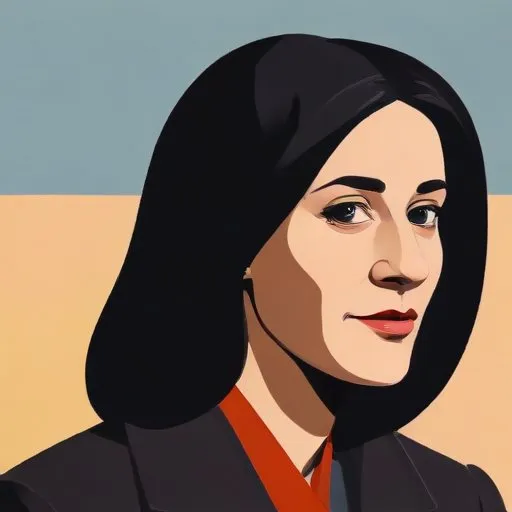
A Polish journalist and author who interviewed and wrote about prominent figures of the Eastern European dissident movement, providing a unique window into the lives of those who shaped the region's history.
Teresa Toraska was a renowned Polish journalist and writer, best known for her groundbreaking book, Oni, which exposed the inner workings of Poland's communist regime and its puppets. This brave and daring piece of investigative journalism earned her widespread acclaim and parallels with the legendary Oriana Fallaci.
Born on January 1, 1944, in Wokowysk, Belarus, Toraska grew up in a world torn apart by war and occupied by the Soviet Union. She graduated from the Warsaw University's Department of Law and began her journalistic career in the 1970s, working for popular Polish weekly Kultura. Her fearless reporting style and unwavering commitment to truth soon made her a household name in Poland.
In the 1980s, Toraska joined the leading Polish migr literary journal Kultura paryska, which was banned in communist Poland and published in Paris, France. Her work with Kultura paryska marked a significant shift in her career, as she began to focus on the darker aspects of Poland's communist past. Her probing interviews and revealing exposés earned her both admiration and criticism, but she remained undeterred in her pursuit of truth.
Toraska's magnum opus, Oni, is a searing indictment of Poland's communist regime and its puppets. The book, published in the United States by HarperCollins, contains candid interviews with five formerly prominent Polish Communists, including Edward Ochab, Jakub Berman, Roman Werfel, Stefan Staszewski, and Jerzy Michałowski. The book's publication was a significant event, as it provided a rare glimpse into the inner workings of the communist machine and shed light on the atrocities committed during that era.
In the 1990s, Toraska ventured into television, hosting two popular programs for Telewizja Polska (TVP): Teraz Wy and Powtórka z PRL-u. Her work in television further cemented her reputation as a fearless and incisive journalist. She also wrote the screenplay for the documentary film Dworzec Gdański, directed by Maria Zmarz-Kozanowicz, which told the story of Polish Jews forced to leave Poland after the political crisis of March 1968.
Toraska's contributions to journalism and literature are immeasurable. She was a fierce advocate for truth and democracy, and her work continues to inspire generations of journalists and writers. Before her passing in 2013, she was a contributor to Poland's second-largest daily newspaper, Gazeta Wyborcza, where she conducted interviews with leading Polish political figures.
Teresa Toraska's life was a testament to her unwavering commitment to truth and democracy. Her remarkable body of work continues to inspire and educate, serving as a beacon of hope for a better, more just society.
80 Years Old
A prominent dissident and advocate for democracy, known for his courageous opposition to Poland's communist regime and influential writings on politics and history.
Born in 1920
Leader of the Catholic Church from 1978 to 2005, known for helping to end communism in Poland and being a charismatic advocate for human rights and social justice.
Born in 1923
The last communist leader of Poland, who imposed martial law in 1981, but later helped transition the country to democracy. He's a symbol of Poland's complex political past.
99 Years Old
A Polish journalist and politician who played a key role in the country's transition from communism to democracy, serving as the first non-communist prime minister since World War II. He's known for his efforts to reform the Polish economy and politics.
