


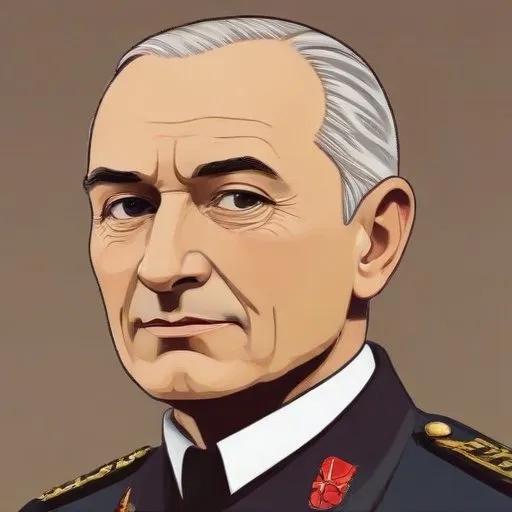
The last communist leader of Poland, who imposed martial law in 1981, but later helped transition the country to democracy. He's a symbol of Poland's complex political past.
Wojciech Jaruzelski is best known for being the last leader of the Polish People's Republic, serving as the First Secretary of the Polish United Workers' Party from 1981 to 1989. During his tenure, he implemented martial law to crush the solidarity movement, a decision that would define his legacy and shape the course of Polish history.
Wojciech Jaruzelski was born on July 6, 1923, in Kurów, eastern-central Poland, to a noble family. In 1941, he was deported with his family to Siberia by the NKVD after the invasion of Poland. He developed photokeratitis during his time in Siberia, forcing him to wear protective sunglasses for the rest of his life.
In 1943, Jaruzelski joined the First Polish Army and fought alongside the Soviets against Nazi Germany in the Eastern Front. He played a key role in the liberation of Warsaw and the Battle of Berlin, earning him recognition as a war hero.
After the war, Jaruzelski became the chief political officer of the Polish People's Army and eventually Polish Minister of Defence in 1968. In 1981, he became the First Secretary of the Polish United Workers' Party, making him the de facto leader of Poland.
During his tenure, Jaruzelski faced significant economic challenges, including a severe debt crisis and shortages of basic goods. In response, he implemented martial law in 1981, which led to the arrest and imprisonment of many solidarity movement activists.
The martial law period, which lasted from 1981 to 1983, was marked by widespread repression and human rights abuses. The regime's actions were condemned by the international community, leading to economic sanctions and diplomatic isolation.
The martial law period had a lasting impact on Polish society, causing widespread disillusionment and mistrust of the government. It also led to the eventual collapse of the communist regime and the rise of democracy in Poland.
In 1989, Jaruzelski stepped down as First Secretary and became President of Poland, a position he held until 1990. He died on May 25, 2014, at the age of 90.
Jaruzelski's legacy is complex and contested. While he is remembered as a war hero and a skilled politician, his decision to implement martial law remains a source of controversy and criticism.
In conclusion, Wojciech Jaruzelski was a complex and influential figure in Polish history, whose decisions and actions shaped the course of the country's development. While his legacy is marked by controversy, he remains an important and fascinating figure in the modern history of Poland.
95 Years Old
The last leader of the Soviet Union, who introduced reforms that led to the end of the Cold War and the collapse of communism, earning a Nobel Peace Prize. He's known for his policies of glasnost and perestroika, which transformed the Soviet Union and the world.
Born in 1911
The charismatic leader who championed conservative policies, helped end the Cold War, and is often credited with restoring American pride and optimism. He's also remembered for his folksy, actor-honed communication style.
Born in 1924
The 41st President of the United States, a decorated war hero and skilled diplomat, led the country through the end of the Cold War and Gulf War. He's known for his foreign policy expertise and "kinder, gentler nation" vision.
Born in 1920
Leader of the Catholic Church from 1978 to 2005, known for helping to end communism in Poland and being a charismatic advocate for human rights and social justice.
Born in 1913
A Polish lawyer and politician who served as the Communist Party's First Secretary, implementing economic reforms and increasing ties with Western Europe. He's known for his attempts to modernize Poland's economy.
98 Years Old
A Polish-born American strategist and policymaker who served as National Security Advisor, shaping US foreign policy and advising presidents on global affairs. Known for his realist approach and expertise on geopolitics.
Born in 1911
A Polish writer and intellectual who explored the human condition, morality, and politics through his novels, essays, and poetry, earning him the Nobel Prize in Literature.
Born in 1926
A renowned filmmaker behind iconic Polish New Wave cinema, known for powerful, poignant, and visually stunning works that often explored Poland's complex history and identity.
