


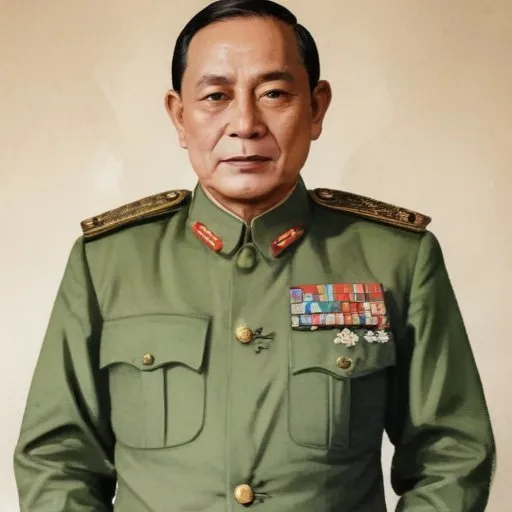
A Burmese general and politician who served as the Prime Minister of Burma from 1992 to 2011, known for his authoritarian rule and human rights abuses.
Than Shwe, a name synonymous with Myanmar's (formerly Burma) tumultuous political landscape, is a retired Burmese army general who held the reins of power as the Chairman of the State Peace and Development Council (SPDC) from 1992 to 2011. During his tenure, he exercised considerable authority, dictating the country's trajectory and leaving an indelible mark on its history.
Born on February 2, 1933, in Minzu village, near Kyaukse, British Burma (now Myanmar), Than Shwe's early life was marked by humble beginnings. His parents, Lay Myint and Seinn Yin, raised him in a modest environment, which laid the foundation for his later rise to prominence.
Than Shwe's educational pursuits took him to Government High School in Kyaukse, where he completed his studies in 1949. Following his education, he began his career as a postal clerk at the Meikhtila Post Office, an unlikely starting point for a man who would eventually shape the nation's destiny.
Than Shwe's path to the top was paved by his entry into the military, a career move that would alter the course of his life. He swiftly rose through the ranks, occupying key positions, including Prime Minister of Myanmar, Commander-in-Chief of Myanmar Defence Services, and head of the Union Solidarity and Development Association (USDA).
As the Chairman of the SPDC, Than Shwe wielded significant influence, directing the country's political, economic, and social landscape. His leadership saw the implementation of various policies aimed at economic development, modernization, and infrastructure improvements.
Than Shwe's governance was marked by both significant achievements and controversy. During his tenure, he faced scrutiny and criticism, particularly regarding allegations of human rights abuses and restrictions on political freedoms. His regime was also marred by internal conflicts and external challenges.
Despite the criticisms, Than Shwe's leadership saw the country make strides in infrastructure development, including the implementation of projects like the Yangon-Mandalay highway and the construction of hydroelectric dams.
In March 2011, Than Shwe officially stepped down as head of state, handing the reins to his chosen successor, Thein Sein. Although he no longer holds public office, Than Shwe continues to wield significant influence within the military.
His legacy is a complex tapestry of both progress and repression, leaving behind a Myanmar that is both modernizing and struggling to overcome its tumultuous past.
Than Shwe's governance has had a lasting impact on Myanmar's social and economic fabric. His policies have shaped the country's political landscape, influencing generations to come.
Love him or loathe him, Than Shwe is an enigmatic figure who has left an indelible mark on Myanmar's history. His legacy serves as a reminder of the complexities of power and the delicate balance between progress and repression.
81 Years Old
A democracy icon and human rights activist, she led the fight against Myanmar's military rule and was awarded the Nobel Peace Prize in 1991.
81 Years Old
A former general who led Myanmar's transition from military rule to democracy, known for his reforms and release of political prisoners.
88 Years Old
A powerful Burmese military officer who served as the Vice-Chairman of the State Peace and Development Council, playing a crucial role in shaping Myanmar's politics and economy. He was instrumental in maintaining the military's grip on power and suppressing democratic movements.
