


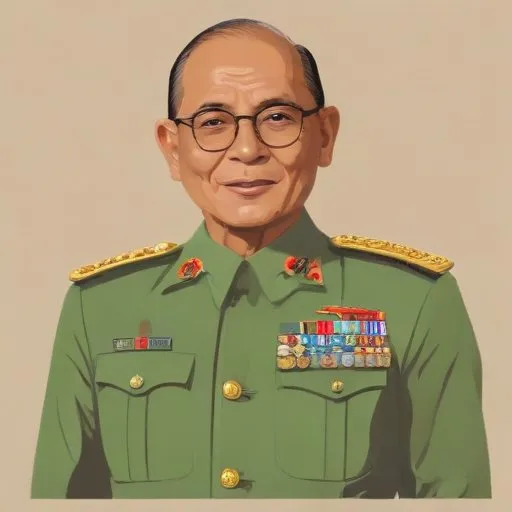
A former general who led Myanmar's transition from military rule to democracy, known for his reforms and release of political prisoners.
Thein Sein is a Burmese politician and retired general in the Myanmar Army, best known for serving as the eighth President of Myanmar from 2011 to 2016, implementing a series of significant political reforms during his tenure.
Born on April 20, 1944, in Kyonku, a small village near Hainggyi Island in what is now Ngapudaw Township, Thein Sein was the youngest of three children to Maung Phyo and Khin Nyunt. His parents were landless farmers, and his father later became a Buddhist monk.
Thein Sein graduated from the 9th intake of the Defence Services Academy with a Bachelor of Arts degree in 1968, becoming a second lieutenant afterward.
Throughout his four-decade long military career, Thein Sein was considered a bureaucrat, not a combat soldier. He served in various positions, including as a major for Sagaing Division's 55th Light Infantry Division and later as a commander for Sagaing Division's 89th Infantry Battalion in Kalay Township.
Thein Sein's political career began when he served as Prime Minister from 2007 to 2011, and later as President of Myanmar from 2011 to 2016.
During his presidency, he implemented several significant reforms, including:
These developments led to Myanmar's appointment to chair ASEAN in 2014, improved relations with the US, the release of Aung San Suu Kyi from house arrest, and the reinstatement of the major opposition party, the National League for Democracy (NLD), in the 2012 by-election.
Thein Sein's presidency marked a significant shift towards democratization and reform in Myanmar, earning him recognition as a reformist leader in the post-junta government.
Despite facing criticism and controversy, his efforts towards political reform have had a lasting impact on Myanmar's political landscape.
Thein Sein's personal life has been marked by significant milestones, including the passing of his mother, Khin Nyunt, and his father's later decision to become a Buddhist monk.
Throughout his life, Thein Sein has demonstrated a commitment to his country and its people, working towards a more democratic and equitable society.
Thein Sein's reforms have had a significant impact on modern Myanmar, paving the way for increased political freedom and improved relations with the international community.
His leadership has inspired a new generation of Burmese citizens to engage in politics and work towards a more democratic future.
Thein Sein's legacy as a reformist leader and his commitment to democratization have made a lasting impact on Myanmar's political landscape.
As a politician and retired general, he has left an indelible mark on his country's history, paving the way for a brighter future for its people.
93 Years Old
A Burmese general and politician who served as the Prime Minister of Burma from 1992 to 2011, known for his authoritarian rule and human rights abuses.
81 Years Old
A democracy icon and human rights activist, she led the fight against Myanmar's military rule and was awarded the Nobel Peace Prize in 1991.
Born in 1910
A Burmese army general and politician who ruled the country with an iron fist, implementing isolationist and nationalist policies that led to economic stagnation and human rights abuses.
