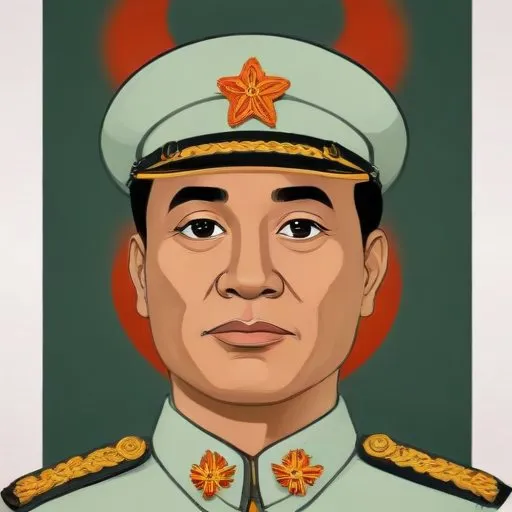
Ne Win

Ne Win

Ne Win was born on May 14th, 1910

Full Name: Ne Win
Place of Birth: British Burma
Nationality: Burmese
Profession: General and Politician
Office: 4th President of Burma
Tenure: 1962-1988
Party: Burmese Socialist Programme Party
Death: 2002

A Burmese army general and politician who ruled the country with an iron fist, implementing isolationist and nationalist policies that led to economic stagnation and human rights abuses.

Timeline
1910
Born in Burma
Ne Win was born on May 14, 1910, in Burma. He would go on to become a Burmese army general and politician.
1930
Studies at Rangoon University
Win studied at Rangoon University, where he became involved in the nationalist movement.
1940
Joins Burma Independence Army
Win joined the Burma Independence Army, fighting against British colonial rule.
1962
Becomes Chairman of Revolutionary Council
Win became the Chairman of the Revolutionary Council, ruling Burma until 1981.
2002
Passes Away
Ne Win passed away on December 5, 2002, leaving behind a legacy as a military leader and politician.
Ne Win

Ne Win Quiz

What was Ne Win's profession before entering politics?

Score: 0/5
FAQ
What was Ne Wins role in Burmese politics?
Ne Win was a Burmese army general and politician who served as the countrys fourth President from 1962 to 1988, implementing a range of socialist and nationalist policies.
What were Ne Wins key policies?
Ne Wins key policies included the nationalization of industries, the promotion of Buddhism, and the isolation of Burma from the international community.
What was Ne Wins relationship with the military?
Ne Win was a career military officer who used the military to maintain power and suppress opposition, establishing a culture of fear and repression in Burma.
What was Ne Wins stance on democracy?
Ne Wins stance on democracy was hostile, and he suppressed pro-democracy movements and opposition parties, including the National League for Democracy led by Aung San Suu Kyi.
What is Ne Wins legacy in Burmese politics?
Ne Wins legacy in Burmese politics is as a repressive and authoritarian leader who isolated and impoverished the country, while consolidating power and wealth for himself and his allies.

Related People:

U Nu

Born in 1907

First Prime Minister of Burma, leading the country to independence from British colonial rule and establishing a democratic government. He's also known for his efforts to promote Buddhism and national unity.

Ba U

Born in 1887

Led the country through a tumultuous period of transition from British colonial rule to independence, implementing key reforms and shaping Burma's early years of self-governance.

Sukarno

Born in 1901

Led Indonesia to independence from the Netherlands, serving as the country's first president and implementing a policy of nationalization and industrialization. He's known for his charismatic leadership and vision for a unified Indonesia.

Lee Kuan Yew

Born in 1923

The founder of modern Singapore, who transformed the country from a poor post-colonial state to a thriving economic powerhouse through visionary leadership and pragmatic policies. He is revered for his role in shaping Singapore's identity and prosperity.

Park Chung Hee

Born in 1917

A South Korean general and politician who led the country through rapid economic development and modernization, known for his authoritarian rule and economic reforms.

Chiang Kai-shek

Born in 1887

Led the Nationalist Party in China, fighting against the Communist Party and later establishing the government of Taiwan. He's known for his role in shaping modern Chinese history.

Zhou Enlai

Born in 1898

The first Premier of the People's Republic of China, serving from 1949 until his death in 1976, is most known for his key role in the Chinese Communist Party and his diplomatic efforts to improve relations with the West. He played a crucial part in shaping China's foreign policy and economy during a pivotal period in the country's history.