


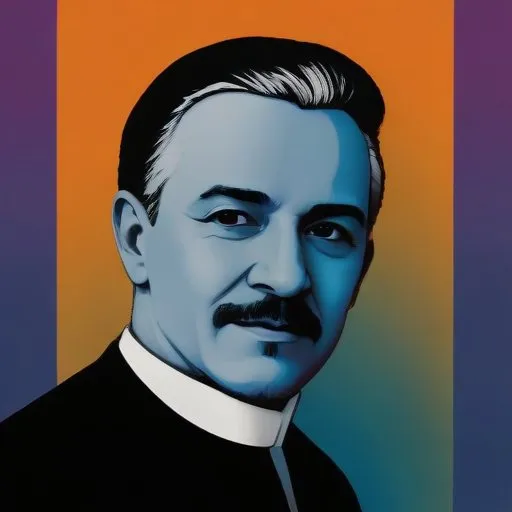
Founded the Boston Archdiocesan Choir School, a renowned institution for liturgical music education, and composed sacred music that continues to inspire generations.
Theodore Marier was a renowned church musician, educator, arranger, and scholar of Gregorian Chant, best known for founding the St. Paul's Choir School in Cambridge, Massachusetts, and serving as the second president of the Church Music Association of America.
Marier's fascination with Gregorian Chant began in the 1930s when he heard a 78 rpm recording of the choir of the Abbey of Solesmes, France, which he described as "the most beautiful music I had ever heard." This sparked a lifelong passion for the genre, leading him to study at Solesmes under the guidance of Dom Joseph Gajard.
A graduate of Boston College, Marier went on to become the director of band music from 1934 to 1942. He earned a master's degree from Harvard in 1940 and later held positions as a choir director or lecturer at Emmanuel College, Newton College of the Sacred Heart, and Boston University.
In 1934, Marier began a 52-year musical tenure at The Church of St. Paul in Harvard Square, Cambridge, initially as an organist and later as choir director from 1947. During this time, he encouraged the composition of new sacred works by contemporary composers, including Russell Woollen's "Missa Quis sicut te" in 1962.
In 1963, Marier co-founded the St. Paul's Choir School with Monsignor Augustine F. Hickey, which he directed until his retirement in 1986. The school has since been renamed the Boston Archdiocesan Choir School, and the choir, the Boston Boy Choir, although it has recently reverted to its original name.
Marier was a faculty member of the Pius X School of Liturgical Music at Manhattanville College in the 1950s, where he contributed to editing The Pius X Hymnal (1953, 2nd ed. 1956). He also served as president of the Church Music Association of America from 1966 to 1986, succeeding Rembert Weakland.
Throughout his career, Marier emphasized the importance of preserving and promoting the rich cultural heritage of Gregorian Chant. He believed that this sacred music could bring people closer to God and foster a deeper sense of spirituality.
In recognition of his outstanding contributions to sacred music, Marier received the Justine Bayard Ward Professorship after his retirement from St. Paul's in 1986.
Theodore Marier's tireless efforts to promote and preserve Gregorian Chant have left an indelible mark on the world of sacred music. His legacy continues to inspire generations of musicians, composers, and music lovers alike, ensuring that the beauty and spirituality of this ancient music tradition remain vibrant and alive.
Through his work, Marier has shown us that music can be a powerful tool for building bridges between people, cultures, and faiths, and that the timeless beauty of Gregorian Chant can continue to inspire and uplift us in our modern world.
Born in 1822
A Belgian organist and composer who created iconic works that blended Romanticism and Impressionism, leaving a lasting impact on classical music.
Born in 1844
A renowned French organist and composer, he was a master of the symphonic organ style, creating iconic works that showcased the instrument's grandeur. His compositions continue to inspire and influence organ music today.
Born in 1886
A renowned French organist and composer, known for his virtuosic performances and contributions to the organ repertoire, including symphonic poems and chamber music.
Born in 1908
A French composer and ornithologist who merged birdsong with avant-garde music, creating a unique and influential sound. His work continues to inspire musicians and bird enthusiasts alike.
Born in 1924
A renowned French organist and composer, he was a master of improvisation and created numerous works for the organ, earning him a reputation as one of the most innovative and influential organists of the 20th century.
