


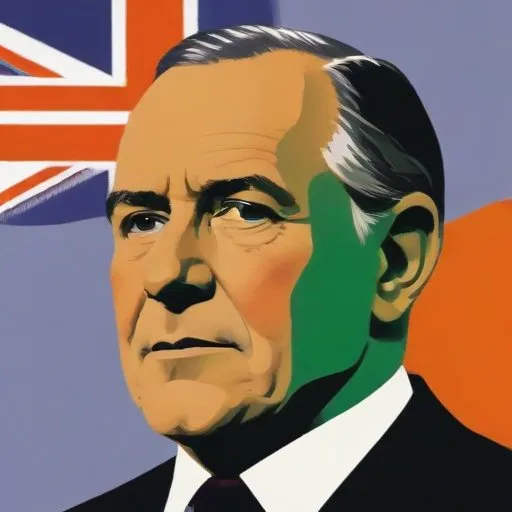
This Irish-Australian politician served as the 15th Premier of New South Wales, playing a significant role in shaping the state's development and governance. He's most known for his contributions to education and infrastructure reforms.
Thomas Waddell, an Australian politician, is renowned for being the premier of New South Wales for a brief yet remarkable 75 days in 1904, making him the shortest-serving premier in the state's history. This distinction, albeit short-lived, is a testament to his remarkable political career, which spanned over three decades.
Born on January 1, 1854, in County Monaghan, Ireland, Waddell was brought to Australia as an infant and grew up near Lake George, New South Wales. He received his education at Collector public school and later at George Metcalfe's High School in Goulburn.
Waddell's journey into politics began at the tender age of 15, when he became a shop assistant. He later worked as a clerk of petty sessions at Collector Court and eventually ventured into the cattle and horse trade in 1876. His entrepreneurial spirit led him to acquire three stations in far western New South Wales, which he managed with his brother George for five years before selling them during the 1880s boom.
In February 1887, Waddell was elected as the member for Bourke in the Legislative Assembly, marking the beginning of his distinguished political career. He married Elizabeth, daughter of John James of Orange, in May 1887. Although he lost his seat to James Peter Howe in the 1891 election, he won it back in a byelection following Howe's resignation in October 1891.
Waddell's subsequent electoral victories included winning the seat of Cobar in 1894 and Cowra in 1898. His impressive performance earned him the position of colonial treasurer in the See government in April 1901, where he demonstrated his financial acumen during challenging times.
When Premier See resigned in June 1904, Waddell was appointed as the premier of New South Wales, a position he held for 75 days. Although his tenure was brief, it was significant, as he navigated the government through a general election, securing his own re-election to the renamed seat of Belubula.
Throughout his political career, Waddell was known for his Progressive Party affiliations and his ability to manage finances effectively. His impact on New South Wales politics and economy remains a testament to his dedication and perseverance.
Waddell's later life was marked by his appointment to the New South Wales Legislative Council in 1917, a position he held until 1934. He passed away on October 25, 1940, leaving behind a legacy of political distinction and a remarkable 75-day premiership.
Thomas Waddell's remarkable political career serves as a testament to his dedication, perseverance, and financial acumen. His 75-day premiership may have been brief, but its significance endures in the annals of New South Wales politics.
Born in 1815
A pioneering figure in Australian politics, instrumental in shaping the country's federation and unity, known for his tireless advocacy for a unified Australia.
Born in 1820
The 6th Premier of New South Wales, a pioneering leader who played a crucial role in shaping the Australian state's early development, particularly in education and infrastructure.
Born in 1881
A pioneering labor leader who fought for workers' rights and social justice, leading the Communist Party USA during the Great Depression and beyond.
Born in 1831
The 11th Premier of New South Wales, a key figure in Australian politics, known for his leadership during a time of significant social and economic change. He played a crucial role in shaping the state's development.
Born in 1903
Academy Award-winning film editor behind iconic movies like "Body Heat" and "Fatal Attraction", known for his mastery of suspenseful storytelling and razor-sharp cutting techniques.
85 Years Old
A British musician and songwriter, best known for being a founding member and original lead vocalist of the Animals, a prominent rock band in the 1960s.
Born in 1857
The 16th Premier of New South Wales, a key figure in Australian politics, known for his significant contributions to the country's education and infrastructure development. He played a crucial role in shaping the state's future during his tenure from 1904 to 1907.
Born in 1915
Noted for his iconic role as Hamilton Burger, the prosecutor who frequently clashed with Perry Mason, and for his prolific screenwriting credits in film and television.
