


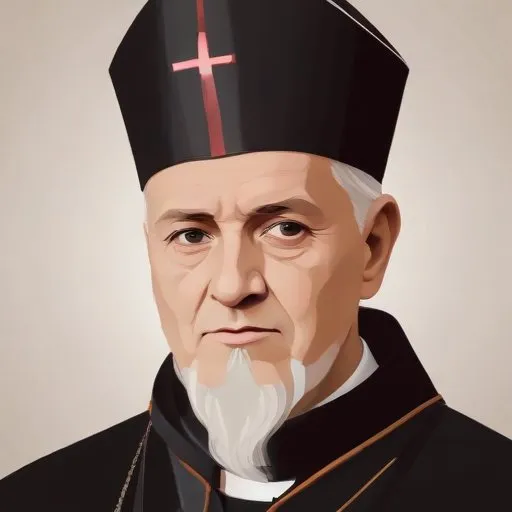
A 16th-century Polish bishop who played a key role in the Protestant Reformation, advocating for Church reform and supporting prominent figures like Martin Luther. He's also known for his diplomatic efforts to unite European Protestant leaders.
Tiedemann Giese, a 16th-century Bishop of Kulm and later Prince-Bishop of Warmia, is renowned for his unwavering support of mathematics, astronomy, and theology, which led him to mentor prominent scholars, including the illustrious Nicolaus Copernicus.
As a prolific writer and correspondent, Giese published numerous works on the reformation of the Church, showcasing his commitment to the pursuit of knowledge and his progressive views on theology.
Born on June 1, 1480, in Danzig, Gdask, Poland, Tiedemann Giese was the fifth child of Albrecht Giese and Elisabeth Langenbeck, both members of wealthy merchant families. His paternal family had emigrated from Cologne to Danzig in the 1430s.
Giese's academic pursuit began at the University of Leipzig, where he enrolled at the age of 12, alongside his cousin, Johann Ferber. He subsequently studied at Basel and in Italy, earning a Master of Theology degree. This educational background solidified his position as one of the best-educated scholars in Prussia.
In 1504, Giese became a priest at the Catholic Church of St. Peter and St. Paul, and later served as secretary to the King of Poland. His intellectual prowess and theological expertise led to his appointment as canon of Frauenburg (Frombork) in 1511, a position he held for 30 years.
The King of Poland appointed Giese as Bishop of Kulm on September 22, 1537, a position ratified by the Pope on January 11, 1538. Toward the end of his life, he became Bishop of Ermland, a testament to his growing influence within the Church.
Giese's legacy extends far beyond his episcopal appointments. As a humanist and liberal in the Erasmian mold, he demonstrated relative tolerance towards Lutherans, making himself a spokesperson for a group of liberal and tolerant men who sought to mediate between the old believers and the reformers.
His patronage of mathematics, astronomy, and theology led to the nurturing of young scholars, including Copernicus, whom he mentored and supported. This patronage not only contributed to the development of these fields but also fostered a culture of intellectual curiosity and innovation.
Giese's philosophical contributions are marked by his commitment to the pursuit of knowledge and his progressive views on theology. As a humanist, he emphasized the importance of education, critical thinking, and intellectual freedom.
His liberal stance within the Church paved the way for a more inclusive and tolerant approach to theology, one that recognized the value of human reason and empirical observation. This approach not only influenced his contemporaries but also left a lasting impact on the development of modern theology.
Throughout his life, Giese was supported by Chancellor Lucas David, a testament to his growing influence within the Church and his commitment to the pursuit of knowledge.
In his later years, Giese became Bishop of Ermland, a position that cemented his legacy as a prominent figure within the Church. His death on October 23, 1550, marked the end of an era, but his contributions to mathematics, astronomy, and theology continue to inspire and influence scholars to this day.
Giese's legacy extends far beyond his own lifetime, influencing the development of modern society in profound ways. His patronage of mathematics, astronomy, and theology contributed to the emergence of new scientific disciplines, paving the way for groundbreaking discoveries and innovations.
His commitment to intellectual freedom, critical thinking, and human reason has inspired generations of scholars, thinkers, and intellectuals, shaping the course of modern thought and inquiry.
In conclusion, Tiedemann Giese's remarkable life and legacy serve as a testament to the power of human curiosity, intellectual freedom, and the pursuit of knowledge. As a bishop, patron, and scholar, he left an indelible mark on the development of modern society, one that continues to inspire and influence us to this day.
