


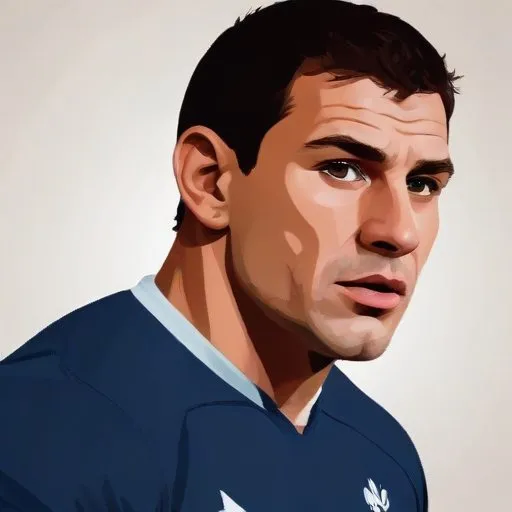
A flanker who played 44 times for England and was a key player in the 1995 Rugby World Cup, known for his aggressive and physical playing style.
Tim Rodber, a former English rugby union footballer, is renowned for his remarkable skills on the field, playing at number eight, flanker, or lock for Northampton Saints, England, and the British and Irish Lions. With a stellar career spanning over a decade, Rodber etched his name in the annals of rugby history, showcasing his extraordinary talent and dedication to the sport.
Rodber was born on July 2, 1969, and grew up with an innate passion for rugby. He excelled in the sport from a young age, representing his school and local sides, Petersfield R.F.C. and Oxford Old Boys. He later attended Churchers College and studied biology at Oxford Polytechnic (now Oxford Brookes University) on Army scholarships.
Rodber's sense of duty led him to become a captain in the Green Howards infantry regiment of the British Army. He remained a captain even after rugby turned professional, eventually resigning in 2001 after retiring from the sport.
In 1987, Rodber joined the Northampton Saints academy and went on to become club captain. During his time with the Saints, he started in the victorious 2000 Heineken Cup Final, where the team defeated Munster.
Rodber made his debut for England in the 1992 Five Nations Championship, where England defeated Scotland 25-7. He delivered impressive performances, including helping England win the 1993 Rugby World Cup Sevens title. On the 1994 England tour of South Africa, Rodber played a crucial role in one of England's best away performances of the decade during the 32-15 First Test win at the Loftus Versfeld Stadium in Pretoria.
In the subsequent tour game against Eastern Province, Rodber became one of the few Englishmen in the 1990s to be sent off when he was given a red card for reacting to violence, including a stamp on teammate Jon Callard. This incident may have possibly prevented his later selection as England captain. Rodber claimed that the aftermath of the sending off limited his physicality when playing, thus negatively impacting his performance, until 1997.
Rodber's remarkable career was punctuated by his selection to the 1997 British and Irish Lions tour of South Africa. He earned 44 caps for England and was an integral part of the team that reached the 1995 Rugby World Cup quarterfinals. Rodber's contributions to the sport have cemented his place as one of the greatest rugby union footballers of all time.
After retiring from rugby, Rodber went on to pursue a successful business career. His unwavering dedication to his craft and his country has inspired generations of rugby players and fans alike. Tim Rodber's ferocious playing style, combined with his exemplary leadership and sportsmanship, have made him a beloved figure in the world of rugby union.
53 Years Old
A former English rugby union player and captain, known for his impressive career with the national team and his current work as a television commentator.
56 Years Old
Former England rugby team captain and coach, leading the team to World Cup victory in 2003, and known for his tough, no-nonsense leadership style.
46 Years Old
A legendary fly-half who led England to Rugby World Cup victory in 2003 with a dramatic last-minute drop goal, earning iconic status in the sport.
51 Years Old
A dual-code rugby legend who excelled as a player and coach in both league and union, earning numerous accolades and inspiring a generation of rugby enthusiasts.
54 Years Old
A former scrum-half who won 51 caps for England and was a key player in their 2003 Rugby World Cup-winning team, known for his pace, vision, and passing ability.
64 Years Old
A former England rugby union player who won 64 caps and was a key figure in the team that won the 2003 Rugby World Cup, known for his tough and physical playing style.
