


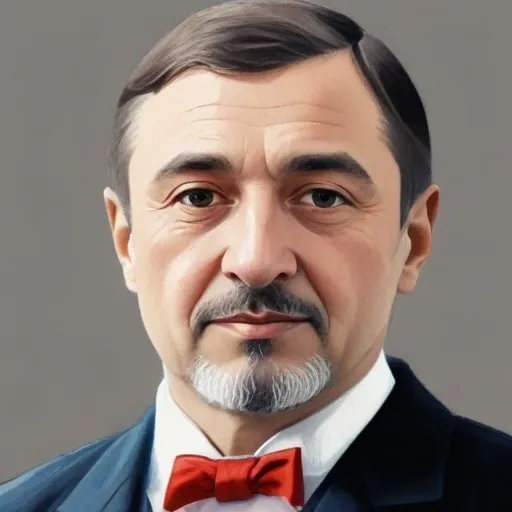
A Bulgarian educator and activist who fought for Macedonian independence and unity, leading the Internal Macedonian Revolutionary Organization. He's known for his role in the country's struggle for freedom.
Aleksandrov was born on March 4, 1881, in Novo Selo, Kosovo vilayet, in the Ottoman Empire (present-day Štip, North Macedonia). He came from a family of modest means, with his father, Aleksandar Poporushev, and mother, Marija Aleksandrova, instilling in him a strong sense of national identity and a desire for education.
After completing his education at the Bulgarian Pedagogical School in Skopje in 1898, Aleksandrov went on to attend the Bulgarian Men's High School in Thessaloniki. This solid educational foundation laid the groundwork for his future leadership roles in the Macedonian liberation movement.
In 1903, Aleksandrov distinguished himself as an extraordinary leader and organizer of the Koani Revolutionary District. His remarkable skills and charisma caught the attention of the Ottoman authorities, who arrested him on March 3, 1903, and sentenced him to five years of solitary confinement. After serving part of his sentence, he was released in April 1904 following an amnesty.
Upon his release, Aleksandrov continued to work tirelessly for the Macedonian cause, cooperating with fellow revolutionaries Todor Lazarov and Mishe Razvigorov to organize the Štip Revolutionary District. His dedication and strategic thinking earned him a reputation as a mastermind of the liberation movement.
In the early stages of his career, Aleksandrov advocated for the annexation of Macedonia to Bulgaria. However, as he delved deeper into the complexities of the region's politics, he began to envision an independent Macedonian state, free from the shackles of Ottoman rule and Bulgarian domination.
This paradigm shift in his thinking did not go unnoticed, and Aleksandrov's new stance sparked controversy among his contemporaries. Nevertheless, his commitment to the cause remained unwavering, and he continued to work towards realizing his vision of an autonomous Macedonia.
In North Macedonia, Aleksandrov's complex legacy has sparked intense debate. Historically dismissed by Yugoslav Macedonian historiography as a Bulgarophile and national traitor, he has more recently been acknowledged as an ethnic Macedonian and a crucial figure in the country's historical heritage.
This reevaluation of Aleksandrov's role in Macedonian history has been met with both praise and criticism, highlighting the ongoing struggles of the region to come to terms with its complex past.
Todor Aleksandrov's vision of an independent Macedonia continues to inspire and influence the region's politics and identity. His leadership and revolutionary spirit serve as a beacon of hope for those seeking autonomy and self-determination.
As the world grapples with the complexities of nationalism, identity, and sovereignty, Aleksandrov's story serves as a poignant reminder of the power of dedication, perseverance, and visionary thinking in shaping the course of human history.
Born in 1866
Prime Minister of Bulgaria from 1926 to 1931, known for his role in the country's interwar period and his attempts to stabilize the economy.
