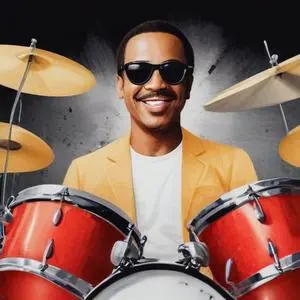
Tony Williams: The Revolutionary Jazz Drummer
A Pioneering Force in Jazz Fusion
Tony Williams is widely regarded as one of the most influential jazz drummers of all time, known for his trailblazing work with
Miles Davis' Second Great Quintet and his own groundbreaking group, the Tony Williams Lifetime. At just 17, Williams joined Davis' quintet, contributing to some of the most iconic albums in jazz history, including "E.S.P." and "Nefertiti".
Early Life and Career
Born on December 12, 1945, in Chicago, Illinois, Williams grew up in Boston, Massachusetts, where he began studying drums at the age of 11 with renowned drummer Alan Dawson. His prodigious talent led to professional gigs at just 13, playing with saxophonist
Sam Rivers. By 16, Williams was already making waves in the jazz scene, catching the attention of saxophonist Jackie McLean, who hired him for a series of performances.
The Second Great Quintet
Williams' most pivotal moment came when he joined Miles Davis' Second Great Quintet, alongside
Herbie Hancock,
Wayne Shorter, and
Ron Carter. This iconic group redefined the sound of jazz, incorporating complex harmonies, polyrhythms, and metric modulation. Williams' innovative approach to drumming, as Davis described, became the "center that the group's sound revolved around".
The Tony Williams Lifetime
In 1969, Williams formed the Tony Williams Lifetime, a pioneering band that fused jazz with rock and electronic elements. The group's debut album, "Emergency!", marked a departure from traditional jazz, introducing a new era of experimentation. With guitarist
John McLaughlin and organist Larry Young, Lifetime pushed the boundaries of jazz, paving the way for future fusion groups.
Impact and Legacy
Tony Williams' influence on modern jazz and fusion is immeasurable. His innovative drumming style, characterized by complex time signatures and polyrhythms, has inspired generations of musicians. Williams was inducted into the Modern Drummer Hall of Fame in 1986, a testament to his enduring impact on the world of jazz.
Discography Highlights
- "Life Time" (1964) - Williams' debut album as a leader
- "Spring" (1965) - A showcase of Williams' early drumming style
- "Emergency!" (1969) - The debut album of the Tony Williams Lifetime
- "Turn It Over" (1970) - Featuring Jack Bruce on bass and vocals
- "Believe It" (1975) - With The New Tony Williams Lifetime
Personal Life and Honors
Williams was of African, Portuguese, and Chinese descent. He passed away on February 23, 1997, leaving behind a legacy that continues to inspire musicians and fans alike. Among his many accolades, Williams was awarded multiple Grammy nominations and was named "probably the best drummer in the world" by music critic
Robert Christgau in 1970.
FAQ
What is Tony Williams most famous band?
Tony Williams most famous band is the Tony Williams Lifetime, which was a pioneering jazz-rock fusion group in the 1960s and 1970s. The band featured Williams on drums, John McLaughlin on guitar, and Larry Young on organ.
What is Tony Williams style of drumming?
Tony Williams style of drumming is highly distinctive and influential. He is known for his technical virtuosity, complex rhythmic concepts, and ability to blend jazz, rock, and funk influences.
Who has Tony Williams collaborated with?
Tony Williams has collaborated with some of the biggest names in jazz, including Miles Davis, Herbie Hancock, and Wayne Shorter. He has also worked with rock and pop musicians, including Eric Clapton and Carlos Santana.
What is Tony Williams contributions to jazz fusion?
Tony Williams contributions to jazz fusion are immense. He was one of the first drummers to bring rock and funk influences into jazz, creating a new and innovative sound that paved the way for future generations of musicians.
What is Tony Williams legacy in jazz?
Tony Williams legacy in jazz is one of innovation, creativity, and passion. He has inspired generations of drummers and continues to be revered as one of the greatest drummers of all time.