


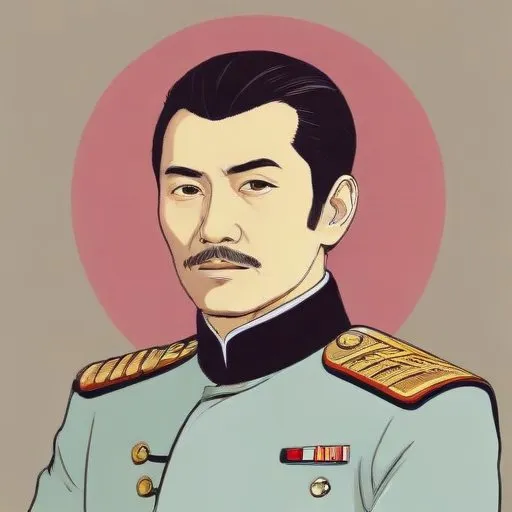
A Japanese Imperial Army general who played a key role in the invasion of China and was later convicted of war crimes. He was a prominent figure in the Second Sino-Japanese War.
Toshiz Nishio, a Japanese general, is renowned for his exceptional strategic prowess during the Second Sino-Japanese War, earning him the reputation as one of the Imperial Japanese Army's most capable and successful commanders. He expertly led the Japanese Second Army during the tumultuous years following the Marco Polo Bridge Incident, leaving an indelible mark on the military history of Japan.
Born on October 31, 1881, in Tottori Prefecture, Japan, Nishio graduated from the 14th class of the Imperial Japanese Army Academy in 1902 and the 22nd class of the Army War College Japan. He was commissioned as a second lieutenant in June 1903 and saw combat during the Russo-Japanese War, participating in the Battle of Sandepu.
Nishio's military career was marked by steady ascendancy, with promotions to lieutenant in February 1905, captain in December 1909, major in November 1916, and lieutenant colonel in August 1920. His leadership skills and tactical acumen led to his appointment as an instructor at the Army War College from 1923 to 1925, followed by his tenure as commanding officer of the 40th Regiment, 10th Division.
Nishio's military prowess and strategic genius came to the forefront during his tenure as Chief of the 1st Section, Inspectorate General of Military Training from 1926 to 1929. He was promoted to major general on August 1, 1929, and assigned to command the 39th Brigade of the IJA 20th Division, stationed in Korea. This marked the beginning of his ascent to the highest echelons of the Imperial Japanese Army.
In 1930, Nishio became Chairman of Military Investigation in the Ministry of War, further solidifying his reputation as a master strategist. His promotion to lieutenant general on August 1, 1933, was followed by his appointment as Head of the 4th Bureau of the General Staff in 1934.
In March 1934, Nishio was appointed Chief of Staff of the Kwantung Army in Manchukuo, where he oversaw the establishment and reorganization of the Manchukuo Imperial Army, as well as the pacification of the region. His tenure in China was marked by significant military victories and strategic successes, cementing his reputation as a brilliant military commander.
In March 1936, Nishio became Vice Chief of the General Staff and Acting Head of the General Affairs Bureau of the General Staff. A brief stint as commander of the Imperial Guards Division in early 1937 preceded his transfer to China, where he played a pivotal role in shaping the military landscape of the region.
Toshiz Nishio's remarkable military career, marked by strategic brilliance and unwavering dedication, left an indelible mark on the history of the Imperial Japanese Army. His contributions to the military campaigns in China and the Second Sino-Japanese War continue to be studied by military historians and strategists around the world.
As a testament to his enduring legacy, Nishio's name is often mentioned alongside other notable Japanese military leaders of the time, including Isamu Chō, Kanji Ishiwara, and Seishirō Itagaki. His remarkable career serves as a reminder of the importance of strategic thinking and effective leadership in the pursuit of military objectives.
Toshiz Nishio's remarkable life and career serve as a testament to the enduring power of strategic thinking, military prowess, and effective leadership. His legacy continues to inspire military historians and strategists, offering valuable insights into the art of war and the importance of adaptability in the face of uncertainty.
Born in 1879
A Japanese field marshal and politician who served as the 48th Minister of War, playing a significant role in World War II and later facing trial for war crimes. He was a prominent figure in Japan's military and political circles during a tumultuous period in history.
Born in 1891
A Japanese general who led the defense of Iwo Jima during World War II, also a poet who wrote about the horrors of war.
