


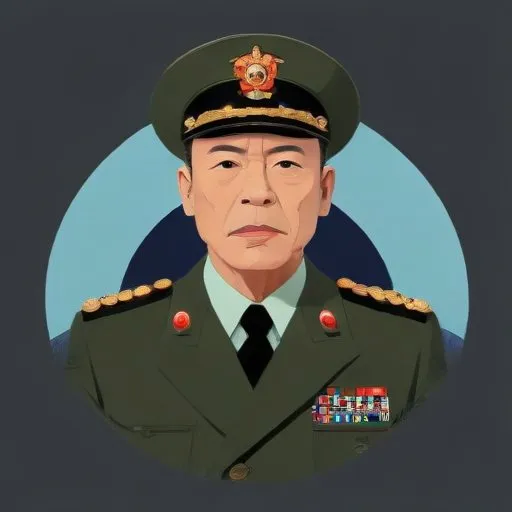
A Japanese field marshal and politician who served as the 48th Minister of War, playing a significant role in World War II and later facing trial for war crimes. He was a prominent figure in Japan's military and political circles during a tumultuous period in history.
Shunroku Hata, a renowned field marshal in the Imperial Japanese Army, is best known for being the last surviving Japanese military officer with a marshal's rank. His remarkable military career spanned over four decades, earning him a place in history as one of Japan's most respected military leaders during World War II.
Hata was born on July 26, 1879, in Fukushima Prefecture, where his father was a samurai of the Aizu Domain. Following his father's death in 1893, Hata enrolled in the Army Cadet School, graduating in 1901 as a second lieutenant in the artillery. He furthered his education at the Imperial Japanese Army Academy, graduating in 1901, and later at the Army Staff College, where he excelled and graduated in 1910.
Hata's military career was marked by significant milestones, including serving in the Russo-Japanese War and later as a military attaché to Germany from 1912 to 1919. During World War I, he remained in Europe as a military observer, gathering valuable insights that would later shape Japan's military strategy. Upon his return to Japan, he was promoted to colonel and given command of the 16th Field Artillery Regiment.
Throughout his career, Hata held various command positions, including commander of the 4th Heavy Field Artillery Brigade, Chief of the Fourth Bureau, and Inspector General of Artillery Training. He was promoted to lieutenant general in 1931 and later became the commander of the 14th Division in 1933.
Following Japan's defeat in World War II, Hata was arrested and tried for war crimes by the Allied Powers. In 1948, he was sentenced to life imprisonment, but was paroled in 1955. After his release, Hata lived a quiet life, passing away on May 10, 1962, at the age of 82.
Hata's legacy is a complex one, marked by both military achievements and controversy. While he was a respected military leader, his involvement in World War II and subsequent conviction for war crimes have tarnished his reputation. Nevertheless, Hata remains an important figure in Japanese military history, serving as a reminder of the country's complex and often tumultuous past.
Hata's remarkable life and military career serve as a testament to his dedication to his country and his profession. While controversy surrounds his involvement in World War II, his legacy remains an important part of Japanese military history.
Born in 1884
Led the Imperial Japanese Navy during World War II, masterminding the surprise attack on Pearl Harbor, and later became a symbol of Japanese military power and strategy.
Born in 1901
The Japanese emperor who ruled from 1926 to 1989, leading the country through World War II and its post-war reconstruction, and is known for his symbolic role in Japanese politics and culture. He is also remembered for his rare public apology for Japan's wartime atrocities.
Born in 1868
A Japanese admiral-turned-politician who served as Prime Minister of Japan, known for his efforts to modernize the country's military and economy. He played a key role in Japan's early 20th-century development.
Born in 1891
A Japanese politician who served as Prime Minister during World War II, known for his role in leading Japan into the war and his attempts to negotiate a peace settlement. He is also infamous for his involvement in the Nanjing Massacre.
