


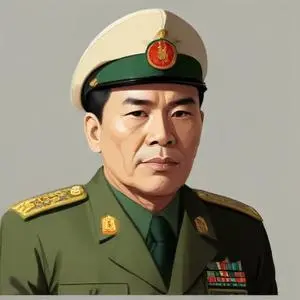
A renowned Vietnamese general and politician who played a crucial role in the Vietnam War, leading the North Vietnamese army to victory against the US and South Vietnam. He's revered as a national hero for his military strategies and patriotic spirit.
V Nguyn Gip, a name synonymous with military genius, was the architect of Vietnam's victories against Japan, France, South Vietnam, and the United States, cementing his position as one of the greatest military strategists of the 20th century. His leadership and vision led the Vietnamese communist forces to triumph over four powerful adversaries, earning him a revered place in Vietnamese history.
Born on August 25, 1911, in Qung Bnh province, Vietnam, Gip hailed from an affluent peasant family. His early involvement in anticolonial political activities laid the foundation for his future as a champion of Vietnamese independence. In 1931, he joined the Communist Party of Vietnam, led by Ho Chi Minh, marking the beginning of his revolutionary journey.
Gip's military prowess came to the forefront during World War II, as he led the Vit Minh resistance against Japanese occupation. Following the war, he spearheaded the anticolonial forces in the First Indochina War against the French, securing a decisive victory at the 1954 Battle of Dien Bien Phu. This triumph led to the signing of the Geneva Accords, granting Vietnam independence from France.
Gip served as the minister of defense of the Democratic Republic of Vietnam (North Vietnam) and the Socialist Republic of Vietnam from 1946 to 1947 and again from 1948 to 1980. He was also the deputy prime minister from 1955 to 1991 and a member of the Politburo of the Communist Party of Vietnam.
In the Vietnam War, Gip masterminded the North Vietnamese army's campaigns against South Vietnam and the United States. He orchestrated the 1968 Tet Offensive and the 1972 Easter Offensive, which marked significant shifts in the war's momentum. After the U.S. withdrawal, Gip led the final push against South Vietnam, securing a decisive victory in 1975.
In the late 1970s, Gip oversaw Vietnam's successful invasion of Cambodia in 1978 and the 1979 Sino-Vietnamese War. He relinquished his post as defense minister in 1980 and left the Politburo in 1982, although he remained on the Central Committee and as deputy prime minister until 1991.
V Nguyn Gip's military genius, strategic thinking, and leadership played a pivotal role in shaping Vietnam's modern history. His victories in four wars against powerful adversaries have cemented his place as a legendary figure in Vietnamese politics and military history.
Gip's legacy extends beyond Vietnam's borders, as his military campaigns served as a beacon of inspiration for national liberation movements worldwide. His influence on modern Vietnamese society, politics, and military doctrine remains profound, ensuring his place as one of the most important figures in Vietnamese history.
Gip passed away on October 4, 2013, at the age of 102, leaving behind a rich legacy that continues to inspire and shape Vietnam's future.
Born in 1890
Leader of North Vietnam during the Vietnam War, unifying the country under communist rule and earning international recognition as a symbol of resistance against colonialism and imperialism.
