


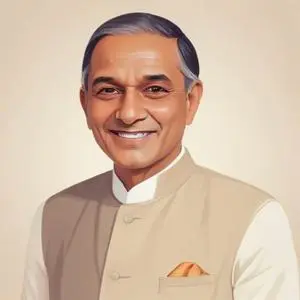
The 7th Prime Minister of India, a champion of social justice, who implemented the Mandal Commission report, providing reservations for backward classes in government jobs and education.
V. P. Singh, the 7th Prime Minister of India, is notoriously remembered for his bold decisions and unwavering stance on issues that defined the country's trajectory in the late 1980s and early 1990s. As a champion of social justice and equality, Singh's implementation of the Mandal Commission report remains one of the most significant and contentious decisions in India's political history.
Born on June 25, 1931, in Allahabad, Uttar Pradesh, Singh hailed from a family of minor nobility, with his father being the Raja Bahadur of Manda. He pursued his education at Allahabad University and Fergusson College in Pune, eventually entering politics in 1969 as a member of the Indian National Congress party.
Singh's meteoric rise in politics began with his election to the Uttar Pradesh Legislative Assembly in 1969. He held various cabinet posts, including Minister of Finance and Minister of Defence, in the Rajiv Gandhi ministry. His tenure as Leader of the Rajya Sabha from 1984 to 1987 further solidified his reputation as a skilled politician.
In 1988, Singh broke away from the Indian National Congress and formed the Janata Dal party by merging various factions of the Janata Party. This bold move led to his election as the 7th Prime Minister of India in 1989, with the support of the Bharatiya Janata Party (BJP) and other allies.
Singh's tenure as Prime Minister was marked by several landmark decisions, including the implementation of the Mandal Commission report, which aimed to provide reservations for Other Backward Classes (OBCs) in government jobs and education. This move sparked country-wide protests, with critics arguing that it would lead to job quotas based on caste.
Singh's opposition to the Ram Rath Yatra, a Hindu nationalist movement, led to the BJP withdrawing its support for the National Front, resulting in his government losing a vote of no-confidence in 1990. He resigned on November 7, 1990, after a stint of 343 days as Prime Minister.
Despite his tumultuous tenure, Singh's contribution to Indian politics remains significant. He is remembered for his unwavering commitment to social justice, his bold stance on issues that mattered, and his role in shaping India's political landscape in the late 20th century.
V. P. Singh's legacy continues to inspire generations of Indian politicians and social activists. His unwavering commitment to social justice and equality has left an indelible mark on Indian politics, paving the way for future leaders to build upon his work.
82 Years Old
The 6th Prime Minister of India, a key figure in Indian politics, known for introducing economic reforms and promoting technology in the country. He was also a strong advocate for social justice and equality.
79 Years Old
The first female President of the Indian National Congress, leading the party to a landslide victory in 2004, and playing a crucial role in shaping India's political landscape.
93 Years Old
The 13th Prime Minister of India, a renowned economist who led the country through a period of rapid economic growth and liberalization, implementing reforms that transformed India's economy. He is credited with helping to lift millions of people out of poverty.
75 Years Old
The Chief Minister of Gujarat and 14th Prime Minister of India, a prominent figure in Indian politics, known for his economic reforms and nationalist agenda. He has been a dominant force in Indian politics for over two decades.
Born in 1924
A renowned Indian poet and politician who served as the country's 10th Prime Minister, known for his efforts to strengthen India's economy and improve relations with neighboring countries.
73 Years Old
Indian lawyer and politician who served as the Minister of Law and Justice, known for his key role in shaping India's economic policies and reforms. He was a prominent figure in Indian politics, known for his eloquence and sharp intellect.
74 Years Old
Indian Minister of External Affairs who played a crucial role in shaping India's foreign policy and was known for her exceptional oratory skills and humanitarian work. She was a powerful voice for Indian diplomacy and a champion of women's empowerment.
90 Years Old
The 13th President of India, a seasoned politician and journalist, served as the head of state from 2012 to 2017, playing a key role in shaping the country's economy and foreign policy. He's known for his diplomatic skills and ability to build consensus.
