


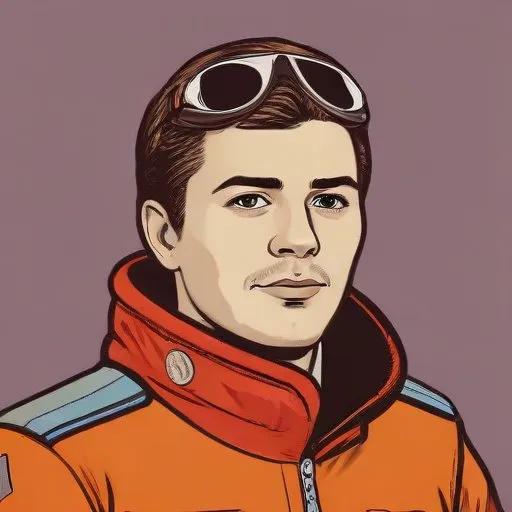
Soviet pilot and cosmonaut instructor who trained many notable cosmonauts, including Yuri Gagarin, the first human in space. He played a crucial role in the Soviet space program's early success.
Valentin Varlamov was a Russian jet pilot and cosmonaut candidate who made history by being selected for Air Force Group 1, the first intake of 20 cosmonaut candidates in 1960. As one of the pioneering individuals in the Russian space program, Varlamov's remarkable journey and achievements have left a lasting impact on the world of space exploration.
Born on August 15, 1934, in Sukhaya Tereshka, Penza oblast, Russia, Varlamov grew up in a family that valued education. After World War II, his family moved to Kyrgyzstan, where he continued his schooling and befriended fellow future cosmonaut candidate, Mars Rafikov. Later, his family relocated to the Orenburg region, where Varlamov completed his education.
Varlamov's passion for flying led him to attend the Air Force introductory school in western Siberia, followed by the Kacha Higher Air Force school and finally the Stalingrad Volgograd Military Aviation school, where he graduated with a commission as a pilot in 1955.
In April 1960, at the age of 25, Varlamov was selected for Air Force Group 1, along with 19 other young pilots, marking the beginning of his journey as a cosmonaut candidate. He began training with fellow candidates, including Anatoly Kartashov, and demonstrated exceptional physical fitness and intelligence.
Varlamov was chosen for a special group of six candidates, known as the Sochi Six, which included Yuri Gagarin, Anatoly Kartashov, Andrian Nikolayev, Pavel Popovich, and Gherman Titov. This elite group underwent accelerated training, preparing them for the country's first human spaceflight mission.
Although Varlamov was disqualified from the space program on medical grounds, his contributions to the Russian space program were instrumental in paving the way for future cosmonauts. He went on to become an instructor at the cosmonaut training center outside Moscow, sharing his knowledge and expertise with others.
Varlamov's legacy extends beyond his own achievements, inspiring generations of pilots and cosmonauts to pursue careers in space exploration. His dedication to the Russian space program has left an indelible mark on the history of space travel.
Valentin Varlamov's remarkable journey serves as a testament to the power of determination, hard work, and sacrifice. His contributions to the Russian space program have inspired countless individuals to pursue careers in space exploration, cementing his place in the annals of history.
92 Years Old
The first human to journey into outer space, paving the way for space exploration and inspiring generations to reach for the stars. A hero and a pioneer in the field of cosmonautics.
Born in 1907
A pioneering rocket engineer and designer who played a crucial role in the Soviet space program, developing the R-7 rocket that launched Sputnik and sent humans into space.
97 Years Old
A Soviet space pioneer who flew on the Vostok 3 mission in 1962, becoming the third person in space and setting a record for the longest solo spaceflight at the time.
Born in 1925
A Soviet hero who flew in space and fought in World War II, known for being the first to command a multi-person spaceflight and receiving the title of Hero of the Soviet Union.
92 Years Old
A Soviet spaceman who became the first human to walk in space during the 1965 Voskhod 2 mission, paving the way for future space exploration.
91 Years Old
A highly decorated Russian military pilot and cosmonaut who flew on several space missions, including a record-breaking 365-day stay on the Mir space station. He's a hero in Russia, celebrated for his bravery and endurance.
Born in 1921
A Soviet physicist and dissident who advocated for human rights and nuclear disarmament, earning a Nobel Peace Prize in 1975. He's known for his courageous stance against the Soviet regime, promoting peace and democracy.
Born in 1926
Russian engineer and astronaut who played a crucial role in the development of the Soviet space program, including designing the Voskhod spacecraft and becoming the first civilian in space.
