


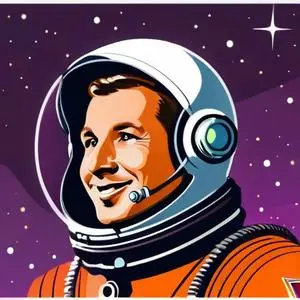
The first human to journey into outer space, paving the way for space exploration and inspiring generations to reach for the stars. A hero and a pioneer in the field of cosmonautics.
Yuri Gagarin, the Soviet pilot and cosmonaut, etched his name in the annals of history by becoming the first human to journey into outer space on April 12, 1961. This pioneering feat, accomplished aboard Vostok 1, cemented Gagarin's status as an international celebrity and earned him the distinction of being the first person to orbit the Earth.
Born on March 9, 1934, in the village of Klushino, Russia, Gagarin's early life was marked by simplicity and hard work. As a foundryman at a steel plant in Lyubertsy, he demonstrated a strong work ethic, which would later prove to be an essential quality in his pursuit of a career in the Soviet Air Forces.
Gagarin's joining the Soviet Air Forces as a pilot marked the beginning of his ascent to fame. Stationed at the Luostari Air Base, near the Norway-Soviet Union border, he honed his flying skills, eventually earning selection into the Soviet space program alongside five other cosmonauts.
The Vostok 1 spacecraft, carrying Gagarin, completed one orbit of the Earth on April 12, 1961, taking 108 minutes to accomplish this remarkable feat. This achievement not only propelled Gagarin to international stardom but also earned him numerous accolades, including the title of Hero of the Soviet Union.
Following his historic flight, Gagarin became the deputy training director of the Cosmonaut Training Centre, which was later renamed in his honor. He was also elected as a deputy of the Soviet of the Union in 1962 and then to the Soviet of Nationalities, respectively the lower and upper chambers of the Supreme Soviet.
Gagarin's life was cut short when the MiG-15 he was piloting with flight instructor Vladimir Seryogin crashed near the town of Kirzhach on March 27, 1968. This tragic event occurred just five weeks after Gagarin completed training at the Zhukovsky Air Force Engineering Academy, marking the end of a remarkable career.
Gagarin's pioneering achievement paved the way for future space exploration, inspiring generations of scientists, engineers, and astronauts. His legacy extends beyond the realm of space travel, as he remains an icon of Soviet pride and a symbol of human ingenuity.
Gagarin's remarkable story serves as a beacon of inspiration, encouraging future generations to push the boundaries of human achievement and strive for excellence.
Born in 1907
A pioneering rocket engineer and designer who played a crucial role in the Soviet space program, developing the R-7 rocket that launched Sputnik and sent humans into space.
Born in 1894
The Soviet leader who initiated reforms and denounced Stalin's regime, known for his bold policies and iconic shoe-banging incident at the UN.
92 Years Old
A Soviet spaceman who became the first human to walk in space during the 1965 Voskhod 2 mission, paving the way for future space exploration.
96 Years Old
A Soviet space pioneer who flew on the Vostok 3 mission in 1962, becoming the third person in space and setting a record for the longest solo spaceflight at the time.
95 Years Old
A pioneering cosmonaut who flew on two space missions, including the first simultaneous spaceflight with another spacecraft, and later became a prominent military leader. He played a crucial role in the development of the Soviet space program.
90 Years Old
A highly decorated Russian military pilot and cosmonaut who flew on several space missions, including a record-breaking 365-day stay on the Mir space station. He's a hero in Russia, celebrated for his bravery and endurance.
89 Years Old
First woman in space, completing 48 orbits of the Earth in 1963, paving the way for future female astronauts.
95 Years Old
First person to walk on the Moon during the Apollo 11 mission, marking a historic milestone in space exploration.
