


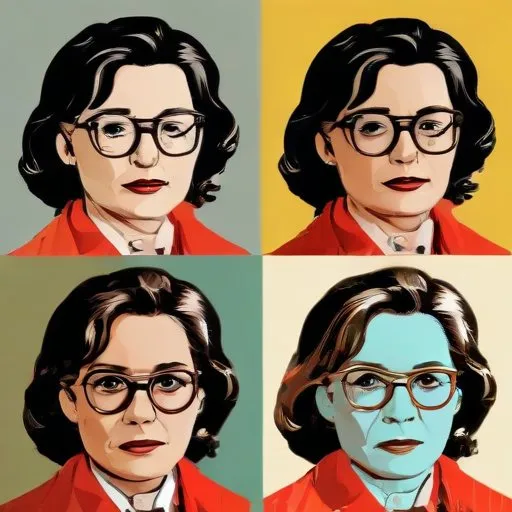
A pioneering African American scientist and inventor who developed the illusion transmitter, a 3D image projection technology, and held numerous patents in the field of computer graphics and engineering.
Valerie Thomas, an American data scientist and inventor, is renowned for her groundbreaking invention of the illusion transmitter, a patented technology that has revolutionized the field of data processing. Her pioneering work in digital media formats has enabled image processing systems to visualize the Earth from space, earning her a prominent place in the history of NASA's Landsat program.
Born on February 8, 1943, in Baltimore, Maryland, Valerie Thomas grew up in an era of integration. She graduated from high school in 1961 and went on to attend Morgan State University, where she was one of only two women majoring in physics. Thomas excelled in her mathematics and science courses, graduating with a degree in physics with highest honors in 1964.
Thomas began her career at NASA in 1964 as a data analyst, where she developed real-time computer data systems to support satellite operations control centers from 1964 to 1970. Her role was instrumental in overseeing the creation of the Landsat program, which enabled the visualization of the Earth from space.
In 1974, Thomas led a team of approximately 50 people for the Large Area Crop Inventory Experiment (LACIE), a joint effort with the NASA Johnson Space Center, the National Oceanic and Atmospheric Administration (NOAA), and the U.S. Department of Agriculture. LACIE demonstrated the feasibility of using satellites to automate the process of predicting wheat yield on a worldwide basis.
Thomas's curiosity was sparked when she attended a science exhibition in 1976, where she witnessed an illusion of a light bulb that appeared to be lit, even though it had been removed from its socket. This inspired her to research and experiment with concave mirrors, leading to her invention of the illusion transmitter. She patented this technology in 1980, which has since had a significant impact on the field of data processing.
Valerie Thomas has received numerous awards and honors for her contributions to science and technology. She has been recognized as a trailblazer in her field, paving the way for future generations of women in STEM.
Valerie Thomas's groundbreaking work has left an indelible mark on the field of data processing and image visualization. Her invention of the illusion transmitter has enabled scientists to visualize and understand the Earth from space, contributing to significant advancements in fields such as agriculture, climate science, and environmental monitoring.
Through her pioneering work, Valerie Thomas has inspired countless individuals to pursue careers in science, technology, engineering, and mathematics (STEM). Her legacy serves as a testament to the power of innovation, curiosity, and determination.
Born in 1918
Trailblazing African-American woman who calculated flight trajectories for NASA's early space missions, including Alan Shepard's historic Mercury launch.
51 Years Old
Former NBA player and current ESPN analyst, known for his colorful commentary and in-depth analysis of the game.
Born in 1910
African-American mathematician and NASA employee who played a crucial role in the early years of the space program, breaking racial and gender barriers along the way.
Born in 1902
Developed the onboard computer systems for NASA's Apollo space program, pioneering the field of software engineering and ensuring the safe return of astronauts.
75 Years Old
American physicist and astronaut who broke barriers as the first woman in space, inspiring generations of women in STEM fields. Founded a company to promote science education and literacy.
89 Years Old
First woman in space, completing 48 orbits of the Earth in 1963, paving the way for future female astronauts.
69 Years Old
A trailblazing female astronaut and pilot who commanded the Space Shuttle Discovery, becoming the first woman to do so, and played a crucial role in NASA's space exploration programs.
69 Years Old
First African American woman in space, trailblazing physician and educator who inspired generations of women and minorities in STEM fields.
