


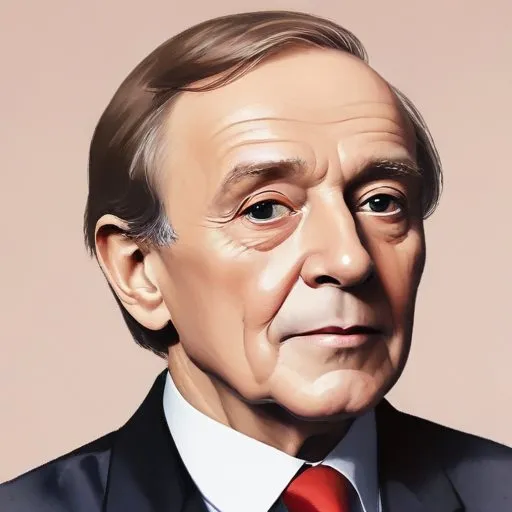
A renowned expert on British politics and constitutional monarchy, known for his insightful writings on the evolution of the British system of government.
Vernon Bogdanor, a renowned British political scientist and historian, is one of Britain's foremost constitutional experts, known for his extensive writings on political and constitutional issues. With a career spanning over five decades, he has been a vocal advocate for the British monarchy and the adoption of proportional representation.
Vernon Bogdanor was born on July 16, 1943, in Staines, to Harry and Rosa Bogdanor (née Weinger). His father, a pharmacist, had Ukrainian roots, while his mother, born in Poland, came to the UK in the 1930s. Both parents were observant Jews. Bogdanor grew up in Uxbridge and was educated at Bishopshalt School.
He went on to excel at The Queen's College, Oxford, where he earned a first-class honors Bachelor of Arts degree in Philosophy, Politics, and Economics (PPE) in 1964.
Bogdanor's academic career began in 1966, when he became a Fellow in Politics at Brasenose College, Oxford. He held various positions, including Senior Tutor (1979-1985 and 1996-1997), Vice-Principal, and Acting Principal (2002-2003). He is currently an emeritus professor of politics and government at the University of Oxford and an emeritus fellow of Brasenose College, Oxford.
In addition to his academic pursuits, Bogdanor has been a Fellow of the Royal Society of Arts, a Fellow of the British Academy, and an Honorary Fellow of the Society for Advanced Legal Studies. He has also been a member of several notable organizations, including the Council of the Hansard Society for Parliamentary Government and the UK Government delegation on Democratic Institutions in Central and Eastern Europe.
Bogdanor's work has been characterized by his strong support for the British monarchy and his advocacy for the adoption of proportional representation. He believes that this system would lead to a more representative and accountable government.
Bogdanor's extensive writings and expertise have made him a respected voice in British politics. His work has influenced policy debates and shaped the understanding of constitutional issues among scholars, politicians, and the general public.
Bogdanor has received numerous awards and honors for his contributions to the field of politics and government. These include fellowships from the Royal Society of Arts and the British Academy, as well as honorary fellowships from the Society for Advanced Legal Studies.
In addition to his academic and professional achievements, Bogdanor has also had a fulfilling personal life. He has been married and has children, and has maintained a strong connection to his Jewish heritage.
Vernon Bogdanor's remarkable career has left an indelible mark on the field of politics and government. His work continues to inspire new generations of scholars and policymakers, and his commitment to promoting constitutional reform and proportional representation remains a beacon of hope for a more just and equitable society.
Through his tireless efforts, Bogdanor has established himself as one of Britain's leading authorities on constitutional matters, and his legacy will continue to shape the course of British politics for years to come.
As a champion of constitutional reform and a steadfast advocate for proportional representation, Vernon Bogdanor has left an enduring legacy that will continue to inspire and educate future generations.
91 Years Old
A renowned expert in electoral politics and voting behavior, known for his insightful analysis and commentary on Canadian and British elections.
83 Years Old
A renowned expert on British politics and constitutional monarchy, known for his insightful writings on the evolution of the British system of government.
73 Years Old
Vice-Chamberlain of the Household, responsible for organizing parliamentary business and ceremonial events, known for their role in supporting the UK government's legislative agenda.
93 Years Old
A renowned expert in comparative politics, he's most known for his work on post-communist democratization and the challenges of building democratic institutions in Eastern Europe and the former Soviet Union.
