


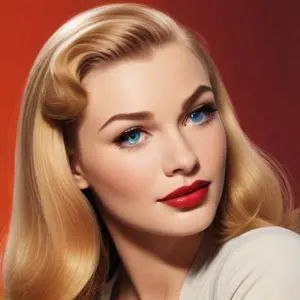
A glamorous Hollywood starlet of the 1940s, known for her peek-a-boo hairstyle and sultry on-screen presence in film noir classics.
Veronica Lake was the epitome of 1940s Hollywood glamour, known for her striking peekaboo hairstyle, sultry on-screen presence, and iconic film noir roles opposite Alan Ladd. Her femme fatale characters in movies like Sullivan's Travels (1941) and I Married a Witch (1942) cemented her status as a screen siren, captivating audiences with her mysterious allure and seductive charm.
Born Constance Frances Marie Ockelman on November 14, 1922, in Brooklyn, New York, Lake's early life was marked by tragedy. Her father, Harry Eugene Ockelman, died in an oil tanker explosion in 1932, and her mother, Constance Frances Charlotta, remarried Anthony Keane, a newspaper staff artist, in 1933. Lake adopted her stepfather's surname and attended Villa Maria, an all-girls Catholic boarding school in Montreal, Quebec, Canada, before being expelled.
Lake's entry into the world of showbiz was marked by a series of small roles on stage and screen. Her breakthrough came with the 1941 film Sullivan's Travels, followed by I Married a Witch in 1942, which solidified her on-screen partnership with Alan Ladd. The duo's chemistry was undeniable, and they went on to star in several films together, including This Gun for Hire (1942) and The Blue Dahlia (1946).
Lake's signature hairstyle, which featured a tousled, curled lock of hair over one eye, became an iconic look of the 1940s. The peekaboo hairstyle, as it came to be known, was both a blessing and a curse for Lake, as it overshadowed her acting abilities and typecast her as a sultry siren.
By the late 1940s, Lake's career began to decline, partly due to her struggles with alcoholism. She made only one film in the 1950s and appeared in several television guest roles. However, in the 1960s, Lake made a comeback of sorts, starring in the 1966 film Footsteps in the Snow. Although the role failed to revitalize her career, it marked a turning point in her personal life, as she published her memoir, Veronica: The Autobiography of Veronica Lake, in 1970.
Veronica Lake's impact on film noir and Hollywood's Golden Age is undeniable. Her on-screen presence and sultry charm have influenced generations of actresses, from Barbara Stanwyck to Kim Basinger. Lake's legacy extends beyond her film career, as she remains an icon of 1940s glamour and a symbol of the allure and mystery of Old Hollywood.
"I was a versatile actress, and I didn't have to play the same kind of role all the time. I could play the nice girl, the vamp, the heroine, or the comedienne."
"The most important thing in life is to stop saying 'I wish' and start saying 'I will'."
Lake's personal life was marked by tragedy, including the death of her father at a young age and her struggles with alcoholism. She died on July 7, 1973, at the age of 50, due to complications from hepatitis and acute kidney injury.
Born in 1913
Star of classic Westerns and film noir, known for his tough-guy persona and iconic roles in "Shane" and "This Gun for Hire".
Born in 1905
Star of classic Westerns and romantic comedies, known for his rugged, everyman persona and iconic roles in films like "Sullivan's Travels" and "Ride the High Country".
Born in 1898
Acclaimed filmmaker behind screwball comedies of the 1940s, known for witty dialogue and zany characters in classics like "The Lady Eve" and "Sullivan's Travels".
Born in 1897
Academy Award-winning actor who brought iconic characters to life on stage and screen, including Dr. Jekyll and Mr. Hyde.
Born in 1901
A rugged, versatile actor who excelled in film noir and Westerns, starring in classic movies like "The Great McGinty" and "The Big Combo".
Born in 1907
A Hollywood legend and iconic leading lady of the 1930s-1950s, starring in classics like "Double Indemnity" and "Ball of Fire", known for her versatility and range in film noir and comedy.
Born in 1904
Debonair leading man of Hollywood's Golden Age, starring in iconic romantic comedies and dramas, known for suave charm and witty banter.
Born in 1906
Academy Award-winning filmmaker behind iconic movies like "Some Like It Hot" and "Sunset Boulevard", known for his witty dialogue and genre-bending storytelling.
