


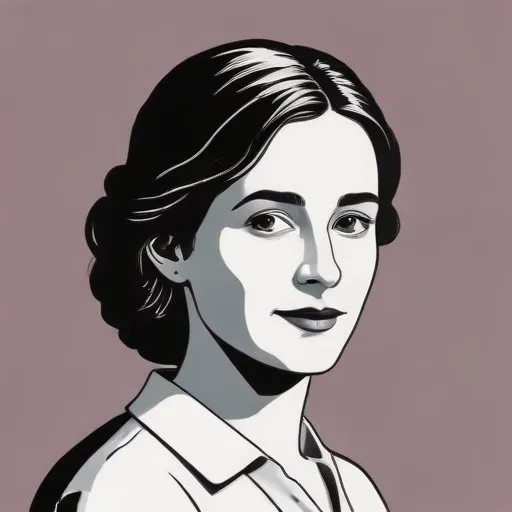
A Flemish writer and poet, known for her lyrical and introspective works that explored themes of love, nature, and the human condition. Her poetry is still widely read and studied in Belgium today.
Virginie Loveling, a Flemish author born on May 17, 1836, is renowned for her prolific writing career, which spanned multiple genres, including poetry, novels, essays, and children's stories. She is particularly notable for her later works, which tackled difficult subjects with unflinching directness, earning her recognition as a pioneering voice in Flemish literature.
Loveling was born in Nevele, East Flanders, Belgium, as the younger sister of Rosalie Loveling, also an author. After their father's death, the family moved to Ghent, where they became part of a circle of French-speaking, anticlerical intellectuals. This environment likely influenced Loveling's writing style, which would later be marked by its intellectual and psychological depth.
Loveling's early writing career was closely tied to her sister Rosalie, with whom she coauthored several collections of poetry, novels, and essays. Their collaborations, such as Gedichten (1870) and Novellen (1874), showcased their romantic and descriptive style, often focusing on rural communities and city bourgeoisie.
After Rosalie's death in 1875, Loveling's writing took a dramatic turn. She began writing novels and essays that addressed difficult subjects with unprecedented directness, earning her recognition for her lack of metaphor and intellectual approach. Her children's stories, too, were marked by their poignant and truthful portrayal of the era.
Loveling's novel Een dure eed (A Costly Oath), published in 1891, received the quinquennial prize for Dutch literature, solidifying her position as a prominent Flemish author. Another notable work is Levensleer (1912), a humorous take on Ghent's French-speaking bourgeoisie, coauthored with her nephew Cyriel Buysse.
Loveling's contributions to Flemish literature were recognized with honors such as Knight in the Order of Leopold (1900) and Commander in the Order of the Crown (1920). Her legacy continues to inspire generations of writers and readers, cementing her place as a pioneering figure in Flemish literary history.
Virginie Loveling's life and work serve as a testament to her unwavering commitment to her craft, her willingness to challenge conventions, and her contribution to the rich tapestry of Flemish literature.
Born in 1830
A Flemish priest who wrote poetry that explored the beauty of nature and the human experience, using a unique blend of traditional and modern styles. His work is still widely read and studied in Belgium today.
