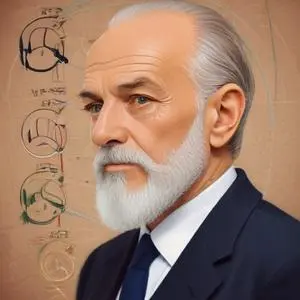
Vito Volterra: The Genius Behind Mathematical Biology and Functional Analysis
The Pioneer of Integral Equations
Vito Volterra, an Italian mathematician and physicist, is renowned for his groundbreaking contributions to mathematical biology and integral equations. As one of the founders of functional analysis, his work has had a profound impact on the development of modern mathematics and physics.
Early Life and Education
Born on May 3, 1860, in Ancona, Italy, Volterra grew up in a poor Jewish family. After his father's untimely death when he was just two years old, his family moved to Turin and later to Florence. It was in Florence that Volterra discovered his passion for mathematics, which ultimately led him to attend the University of Pisa. Under the guidance of Enrico Betti, Volterra's mentor, he began to develop his theory of functionals, which would become a cornerstone of his future work.
Academic Career and Contributions
Volterra's academic career was marked by several notable milestones. In 1883, he became a professor of rational mechanics at the University of Pisa, where he continued to develop his theory of functionals. His work in this field led to the publication of his seminal book,
Theory of Functionals and of Integral and Integro-Differential Equations, in 1930. This comprehensive treatise cemented his reputation as a leading authority in the field.
Volterra's academic pursuits also took him to the University of Turin, where he became a professor of mechanics in 1892, and later to the University of Rome La Sapienza, where he held the position of professor of mathematical physics from 1900 until his retirement.
War Efforts and Later Life
During World War I, Volterra joined the Italian Army and worked on the development of airships under the guidance of Giulio Douhet. It was during this period that he originated the idea of using inert helium instead of flammable hydrogen, a groundbreaking innovation that would later become crucial in the understanding of ductile materials.
In 1905, Volterra was appointed as a senator of the Kingdom of Italy by King Victor Emmanuel III, a testament to his patriotism and dedication to his country.
Legacy and Impact
Vito Volterra's contributions to mathematics and physics have had a lasting impact on the scientific community. His work on integral equations and functional analysis has influenced numerous fields, from biology to physics, and has paved the way for significant advancements in our understanding of complex systems.
Today, Volterra's legacy extends beyond the realm of academia. His work has inspired generations of mathematicians and physicists, and his ideas continue to shape our understanding of the world around us.
Notable Quotes
- "The study of mathematics, like the Nile, begins in minuteness but ends in magnificence."
- "The mathematician starts with a problem and ends with a theory; the physicist starts with a theory and ends with a problem."
Inspirational Story
Volterra's life is a testament to the power of perseverance and dedication. Despite facing numerous challenges, including poverty and personal loss, he remained steadfast in his pursuit of knowledge and innovation. His story serves as a powerful reminder that, with hard work and determination, we can overcome obstacles and achieve greatness.
FAQ
What were Vito Volterras contributions to mathematics?
Vito Volterra was an Italian mathematician and physicist who made significant contributions to the fields of mathematics and physics, including the development of functional analysis.
How did Vito Volterras work impact the development of electromagnetism?
Vito Volterras work on electromagnetism helped to establish it as a major field of study, contributing to our understanding of the behavior of electromagnetic waves.
What were Vito Volterras most famous equations?
Vito Volterras most famous equations are the Volterra integral equations, which are used to describe the behavior of complex systems.
How did Vito Volterras work impact the development of population dynamics?
Vito Volterras work on population dynamics helped to establish it as a major field of study, contributing to our understanding of the behavior of populations and ecosystems.
How is Vito Volterra remembered in the history of mathematics?
Vito Volterra is remembered as a pioneering mathematician and physicist who made significant contributions to our understanding of complex systems and the natural world.