


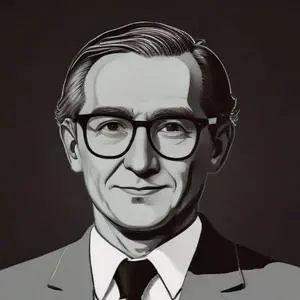
A renowned mathematician and academic who made significant contributions to the fields of differential equations, dynamical systems, and symplectic geometry, earning him numerous awards and honors.
Vladimir Igorevich Arnold was a Soviet and Russian mathematician renowned for his groundbreaking contributions to the field of mathematics, particularly in the areas of dynamical systems, algebra, catastrophe theory, and topology. His most notable achievement is the Kolmogorov-Arnold-Moser (KAM) theorem, which revolutionized our understanding of the stability of integrable systems.
Born on June 12, 1937, in Odesa, Ukraine (then part of the Soviet Union), Arnold was exposed to mathematics from a young age. His father, Igor Vladimirovich Arnold, was a mathematician who instilled in him a passion for numbers. However, Arnold's early experiences with mathematics were not without disappointment. He once asked his father why the multiplication of two negative numbers yielded a positive number, only to be dissatisfied with the axiomatic response. This encounter sparked a lifelong aversion to the axiomatic method, driving Arnold to seek more intuitive and visual approaches to mathematics.
At the tender age of 19, Arnold solved Hilbert's 13th problem, a feat that catapulted him to international recognition. This was just the beginning of a prolific career that saw him make significant contributions to:
Arnold's work paved the way for the development of three new branches of mathematics: topological Galois theory, symplectic topology, and KAM theory. His influence extended beyond mathematics to physics, inspiring a new generation of researchers to adopt a more geometric approach to problem-solving.
A passionate educator, Arnold was known for his engaging lectures, seminars, and textbooks. His popular mathematics books, such as
Vladimir Arnold received numerous accolades for his contributions to mathematics, including:
Vladimir Arnold's impact on modern mathematics is profound and far-reaching. His pioneering work has influenced fields beyond mathematics, inspiring new approaches to problems in physics, engineering, and beyond. As a passionate educator and writer, Arnold has inspired countless mathematicians and physicists, leaving behind a legacy that will continue to shape the world of mathematics for generations to come.
Born in 1903
Developed theories on probability, topology, and complexity, making significant contributions to modern mathematics and computer science.
Born in 1913
A renowned mathematician and biologist who made significant contributions to various fields, including functional analysis, representation theory, and biology, and is known for his work on the theory of distributions and his influence on modern mathematics.
88 Years Old
A renowned mathematician and academic, he was awarded the Fields Medal for his groundbreaking contributions to topology and algebraic geometry. His work has far-reaching implications for our understanding of geometric structures.
Born in 1862
A renowned mathematician and academic who developed infinite-dimensional vector spaces and laid the foundation for quantum mechanics and relativity. He's also famous for his 23 unsolved math problems that shaped 20th-century mathematics.
Born in 1882
A pioneering mathematician and physicist who revolutionized abstract algebra and made groundbreaking contributions to modern physics, particularly in the development of Einstein's theory of general relativity.
Born in 1854
A pioneer in mathematics and physics, he laid the foundations for modern chaos theory, topology, and relativity, making groundbreaking contributions to our understanding of space and time.
