


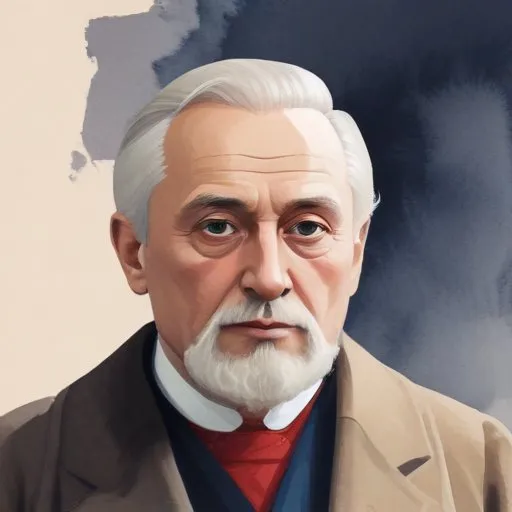
A Russian scholar and critic who developed a groundbreaking theory of narrative structure, identifying 31 fundamental elements that appear in all fairy tales, revolutionizing the study of folklore and literature.
Vladimir Propp, a renowned Soviet folklorist and scholar, revolutionized the way we understand the fundamental structure of stories. Through his groundbreaking work, he identified the simplest, irreducible structural units of Russian folk tales, paving the way for a deeper comprehension of narratives across various forms of media.
Born on April 17, 1895 (O.S.), in Saint Petersburg, Russia, Vladimir Propp came from an assimilated Russian family of German descent. His parents, Yakov Philippovich Propp and Anna-Elizaveta Fridrikhovna Propp (née Beisel), were Volga German wealthy peasants from Saratov Governorate. Propp's educational journey began at Saint Petersburg University, where he majored in Russian and German philology from 1913 to 1918.
Propp's magnum opus, Morphology of the Folktale, was published in Russian in 1928. This seminal work introduced a systematic approach to analyzing the structure of folktales, which would later influence prominent scholars like Claude Lévi-Strauss and Roland Barthes. Although it remained largely unnoticed in the West until its translation in 1958, Morphology has since been widely applied to various forms of narrative, including literature, theatre, film, television, and even games.
In 1932, Propp became a faculty member at Leningrad University (formerly Saint Petersburg University), where he would go on to chair the Department of Folklore until it merged with the Department of Russian Literature in 1938. Throughout his academic career, Propp published several influential books, including:
In addition to these works, Propp penned numerous articles, including "The Magical Tree on the Tomb," "Wonderful Childbirth," "Ritual Laughter in Folklore," and "Oedipus in the Light of Folklore."
Vladimir Propp's pioneering work has had a profound impact on our understanding of narratives and their structural elements. His ideas have been applied across various media platforms, influencing the way stories are told and consumed. Propp's legacy continues to inspire scholars, writers, and creators to explore the fundamental building blocks of storytelling.
As we reflect on Propp's remarkable contributions, we are reminded that the power of storytelling lies in its ability to transcend boundaries and evoke emotions. Vladimir Propp's work serves as a testament to the enduring significance of folklore and the importance of understanding the architecture of narratives that shape our human experience.
Born in 1915
A French philosopher, theorist, and critic who challenged traditional notions of culture, literature, and identity through his influential writings on semiotics, mythology, and structuralism. He's most known for his critical theories on modern society and culture.
99 Years Old
A French historian and philosopher who critiqued power structures and social norms, arguing that knowledge and truth are shaped by those in power. He's known for his concepts of power, discipline, and surveillance.
Born in 1908
A founder of modern anthropology, known for structuralism and deciphering the underlying patterns of human culture and society. His work bridges the gap between sociology, psychology, and philosophy.
Born in 1897
A French philosopher, novelist, and poet who explored the relationships between eroticism, literature, and philosophy, and is known for his concept of "expenditure" and the idea that humans have an innate desire to waste and excess.
95 Years Old
A pioneer of poststructuralism, deconstructing traditional notions of meaning and challenging Western philosophy's core assumptions. His work redefined the way we think about language, culture, and identity.
Born in 1896
A pioneering linguist and theorist who developed groundbreaking concepts in phonology, morphology, and semiotics, shaping modern linguistics and literary theory.
