


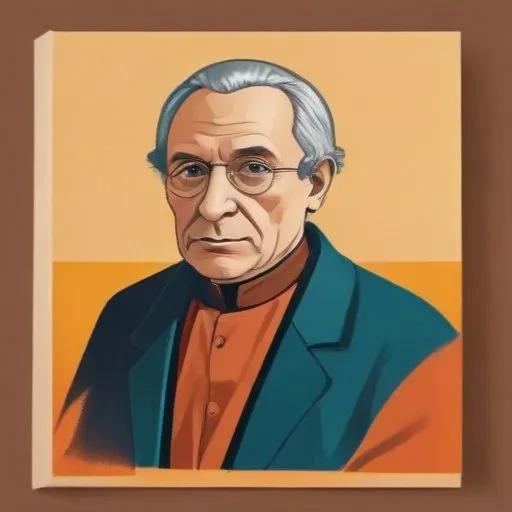
A Russian mathematician and physicist who made significant contributions to the development of mathematical physics, particularly in the fields of differential equations and theoretical mechanics.
Vladimir Steklov was a visionary Russian and Soviet mathematician, mechanician, and physicist who made groundbreaking contributions to the world of science. He is renowned for his remarkable work in the history of science, earning him a revered place among the greatest minds of his time.
Born on January 9, 1864, in Nizhny Novgorod, Russia, Steklov was destined for greatness. He graduated from Kharkov University in 1887, where he was mentored by the illustrious Aleksandr Lyapunov. This marked the beginning of his illustrious academic career, which would take him to new heights of excellence.
Steklov's remarkable contributions to mathematics, mechanics, and physics paved the way for new discoveries and advancements. He worked tirelessly, producing numerous works on the history of science, earning him recognition as an Invited Speaker at the 1924 International Congress of Mathematicians in Toronto.
In 1921, Steklov's unwavering dedication led him to petition for the creation of the Institute of Physics and Mathematics. This vision became a reality, and upon his death, the institute was named after him in recognition of his remarkable achievements. The Mathematics Department eventually split from the institute in 1934, becoming the esteemed Steklov Institute of Mathematics.
Steklov's exceptional contributions earned him a corresponding membership in the Göttingen Academy of Sciences and Humanities in 1926. This prestigious recognition solidified his position as a leader in his field, inspiring future generations of scientists and mathematicians.
Vladimir Steklov's remarkable legacy extends beyond his numerous achievements. He has inspired countless individuals to pursue careers in mathematics, mechanics, and physics, leaving an indelible mark on the world of science. A lunar impact crater bears his name, a testament to his enduring influence.
Steklov's personal life was marked by a deep commitment to his work. He spent his final years in Gaspra, Crimea, USSR, where he passed away on May 30, 1926. He was laid to rest in Saint Petersburg, Russia, leaving behind a legacy that continues to inspire and motivate scientists and mathematicians worldwide.
Vladimir Steklov's remarkable story serves as a beacon of inspiration, reminding us that dedication, perseverance, and innovation can lead to achievements that transcend time and space. His pioneering spirit continues to inspire new generations of scientists, mathematicians, and thinkers, ensuring that his legacy will endure for eternity.
Born in 1850
A trailblazing mathematician and physicist who made groundbreaking contributions to differential equations, integral calculus, and mechanics, paving the way for future generations of women in STEM fields.
Born in 1854
A pioneer in mathematics and physics, he laid the foundations for modern chaos theory, topology, and relativity, making groundbreaking contributions to our understanding of space and time.
Born in 1792
Developed a new branch of geometry, non-Euclidean geometry, which challenged traditional views and paved the way for major advancements in mathematics and physics. His work also influenced the development of Einstein's theory of relativity.
Born in 1862
A renowned mathematician and academic who developed infinite-dimensional vector spaces and laid the foundation for quantum mechanics and relativity. He's also famous for his 23 unsolved math problems that shaped 20th-century mathematics.
Born in 1882
A pioneering mathematician and physicist who revolutionized abstract algebra and made groundbreaking contributions to modern physics, particularly in the development of Einstein's theory of general relativity.
Born in 1856
Developed the theory of Markov chains, a mathematical system that undergoes transitions from one state to another, and is widely used in computer science, biology, and economics.
Born in 1898
A pioneer of montage editing, he revolutionized filmmaking with his iconic scenes and theories, influencing generations of directors.
Born in 1895
A Soviet physicist who developed the concept of the "tokamak," a device used to confine and study plasmas at extremely high temperatures, leading to advancements in nuclear fusion research.
