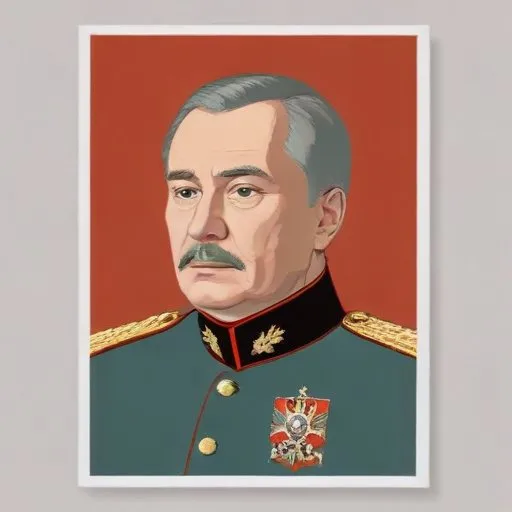
Vladimir Sukhomlinov: The Controversial Russian General
A Legacy of Scandal and Military Failure
Vladimir Sukhomlinov, a Russian general in the Imperial Russian Army, is infamous for his disastrous tenure as the Minister of War from 1909 to 1915, which was marked by allegations of corruption, abuse of power, and high treason. His failure to provide the Russian army with necessary armaments and munitions during World War I led to a string of humiliating defeats, ultimately contributing to the downfall of the Romanov monarchy.
Early Life and Military Career
Born on August 16, 1848, in Telshi, Vilna Governorate, Sukhomlinov was the son of Alexander Pavlovich Sukhomlinov and Olga Ivanovna Lunskaya. His younger brother, Nikolai Sukhomlinov, would go on to become the governor of Orenburg Governorate and the ataman of the Orenburg Cossack Army. Vladimir graduated from the prestigious Nikolayevskoye Cavalry School in 1867 and served in the Uhlans of the Imperial Guard Regiment based in Warsaw.
Rise to Prominence
After graduating from the General Staff Academy in 1874, Sukhomlinov participated in the Russo-Turkish War of 1877-1878, serving on the staff of the renowned General
Mikhail Skobelev. His bravery earned him the Order of St. George, 4th class. Sukhomlinov's military prowess and strategic mind led to his appointment as a lecturer at the General Staff Academy, as well as at the Nicholas Cavalry School, the Corps of Pages, and the Mikhail Artillery School.
Controversies and Downfall
Sukhomlinov's career took a dramatic turn for the worse when he was appointed as the Minister of War in 1909. His tenure was marked by allegations of corruption, nepotism, and mismanagement of military resources. The Russian army's lack of preparedness for World War I was blamed squarely on Sukhomlinov's shoulders, and his ousting in 1915 was met with widespread relief.
Trial and Legacy
Sukhomlinov's trial for high treason, corruption, and abuse of power was a high-profile sensation, drawing widespread media attention and public scrutiny. Although he was eventually acquitted, the damage to his reputation and that of the Imperial Russian government was irreparable. Sukhomlinov's downfall is often seen as a contributing factor to the eventual collapse of the Romanov monarchy.
Personal Milestones and Key Life Events
- August 16, 1848: Born in Telshi, Vilna Governorate
- 1867: Graduated from Nikolayevskoye Cavalry School
- 1874: Graduated from General Staff Academy
- 1877-1878: Participated in the Russo-Turkish War
- 1884-1886: Commanded the 6th Dragoon Regiment at Suwalki
- 1908-1909: Served as Chief of the General Staff
- 1909-1915: Minister of War
- 1915: Ousted as Minister of War and put on trial
- 1926: Died on February 2
Historical Context and Legacy
Sukhomlinov's downfall serves as a cautionary tale of the dangers of unchecked power and corruption. His legacy is a reminder of the devastating consequences of poor leadership and the importance of accountability in government. As a historical figure, Sukhomlinov's story is a fascinating, if tragic, chapter in the annals of Russian history.
FAQ
What is Vladimir Sukhomlinovs role in Russian history?
Vladimir Sukhomlinov was a Russian general who served as the Minister of War from 1909 to 1915. He played a key role in the modernization of the Russian military and was a key figure in the lead-up to World War I.
What is Vladimir Sukhomlinovs military career?
Vladimir Sukhomlinov had a distinguished military career, serving in the Russo-Japanese War and later as the chief of staff of the Russian army. He was known for his reforms and modernization efforts, which aimed to strengthen the Russian military.
What is Vladimir Sukhomlinovs role in World War I?
Vladimir Sukhomlinov played a key role in the early years of World War I, serving as the Minister of War and overseeing the Russian militarys mobilization and early battles. He was eventually dismissed due to Russias military setbacks.
What are Vladimir Sukhomlinovs other achievements?
Vladimir Sukhomlinov was a prolific writer and published several books on military history and theory. He was also a member of the Russian Imperial Academy of Sciences and served as the president of the Russian Military Historical Society.
What is Vladimir Sukhomlinovs legacy in Russian history?
Vladimir Sukhomlinovs legacy in Russian history is complex and contested. While he played a key role in modernizing the Russian military, his tenure as Minister of War was marked by controversy and ultimately, military defeat.