


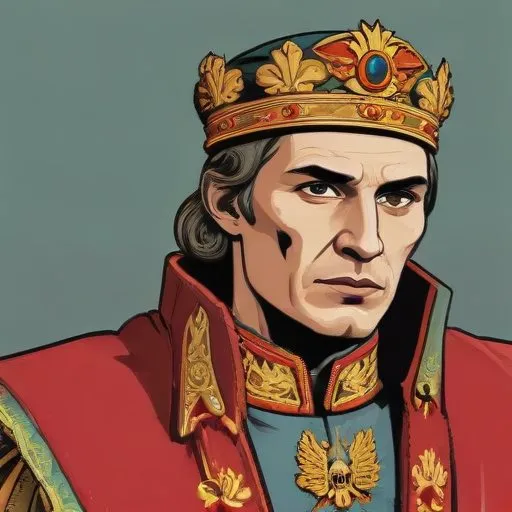
A medieval prince who ruled Kiev and expanded its territories through military campaigns, known for his bravery and strategic prowess. He played a key role in shaping Eastern European politics.
Vladimir the Bold, also known as Vladimir Andreyevich, was a renowned Russian prince who left an indelible mark on the country's history. He is celebrated for his valiant military exploits, particularly in the wars waged by his cousin, Dmitri Donskoi of Moscow, earning him his moniker "the Bold."
Born on July 15, 1353, Vladimir was the son of Andrei Ivanovich, Prince of Novgorod, and grandson of Ivan Kalita, a prominent figure in Russian history. At the tender age of five, Vladimir inherited Serpukhov, Borovsk, and a third part of Moscow from his brother. As his cousin Dmitry of Moscow was also a minor, both princes were placed under the tutelage of Metropolitan Alexis, who arranged a treaty stipulating Vladimir's loyalty to his Muscovite cousin.
Throughout his life, Vladimir remained faithful to this oath, participating in numerous military campaigns alongside Dmitry. These expeditions included the wars against Tver (1375), Ryazan (1385), the Livonian Knights (1379), and the Republic of Novgorod (1392). His unwavering loyalty was tested when he married a daughter of Algirdas of Lithuania in 1371, yet he continued to support Dmitry in his struggle against the Lithuanians.
Vladimir's military prowess was evident in his victories against the Severian towns of Trubchevsk and Starodub in 1377. His crowning achievement, however, was his command of the cavalry in the pivotal Battle of Kulikovo in 1380, which secured a Russian victory. When Tokhtamysh invaded Russia two years later, Vladimir successfully repelled his forces near Volokolamsk.
In 1374, Vladimir demonstrated his foresight by building the first oaken kremlin in Serpukhov, a testament to his commitment to defending his capital. This architectural feat showcased his understanding of the importance of fortifications in warfare.
Vladimir's relationship with his cousin Dmitry was not without its complexities. In 1388, a rift formed between the two princes, although they eventually reconciled the same year. Following Dmitry's death and the ascension of his son Vasily I, Vladimir was forced to surrender Serpukhov and flee to Torzhok. However, he soon returned to his principality and negotiated a treaty with Vasily, acquiring the appanage towns of Volokolamsk and Rzhev in the process.
Later, Vladimir would exchange these towns for Gorodets, Uglich, and Kozelsk, relinquishing his claims to Murom and Tarusa. This series of alliances and feuds highlights Vladimir's ability to adapt to the shifting political landscape and secure advantageous agreements.
Vladimir's final military campaign was a defense of Moscow against the horde of Edigu in 1408. He passed away two years later and was interred in the Archangel Cathedral. His seven sons went on to continue the lineage, ensuring that his legacy endured.
Vladimir the Bold's remarkable life was characterized by unwavering loyalty, military prowess, and strategic thinking. His contributions to Russian history have cemented his place as one of the most celebrated princes of Serpukhov, earning him a lasting reputation as a heroic figure in the annals of Russian history.
Born in 1326
Grand Prince of Moscow who ruled from 1353 to 1359 and strengthened the city's economy and military, establishing it as a major power in Eastern Europe.
Born in 1371
Grand Prince of Moscow who ruled from 1389 to 1425, known for strengthening Moscow's power and establishing it as the center of the Russian Orthodox Church.
Born in 1326
Grand Prince of Moscow who ruled from 1353 to 1359 and strengthened the city's economy and military, establishing it as a major power in Eastern Europe.
Born in 1221
A 13th-century prince who defended Russia against foreign invasions and is revered as a saint in the Orthodox Church for his bravery and wisdom. He's also the subject of a famous Sergei Eisenstein film.
