


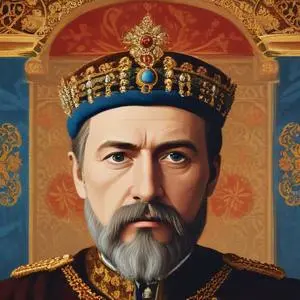
A 14th-century ruler who united warring principalities, ended Mongol rule, and founded the Russian state, earning a heroic reputation in Russian history.
Dmitri Donskoi, also known as Dmitry of the Don, is renowned for being the Grand Prince of Moscow from 1359 to 1389, a period marked by his exceptional military prowess and astute statecraft. His reign is particularly notable for the pivotal Battle of Kulikovo, where he led the Russian armies to a resounding victory against the Golden Horde, securing a crucial triumph for the nascent Russian state.
Born in 1350, Dmitri was the son of Ivan II, the Grand Prince of Moscow, and Aleksandra Vasilievna. Following his father's death in 1359, Dmitri ascended to the throne at the tender age of nine, with his mother acting as regent. During this period, Dmitri's mother played a significant role in shaping his character and preparing him for the challenges of rulership.
The Battle of Kulikovo, fought on September 8, 1380, is widely regarded as a turning point in Russian history. Dmitri, determined to assert Moscow's independence from the Golden Horde, assembled a coalition of Russian principalities and marched against the Mongol forces led by Mamai. Despite being outnumbered, the Russian army, bolstered by Dmitri's strategic prowess, secured a decisive victory, killing Mamai and shattering the Golden Horde's grip on Russia.
The repercussions of the Battle of Kulikovo were far-reaching. The victory cemented Dmitri's reputation as a heroic leader, earning him the sobriquet "Donskoi" (of the Don). Moreover, it marked a significant shift in the balance of power, as Moscow emerged as a dominant force in Eastern Europe, paving the way for its eventual rise as a major power.
During his reign, Dmitri implemented a series of domestic reforms aimed at consolidating Moscow's power and promoting economic growth. He strengthened the Orthodox Church, establishing it as a pivotal institution in Russian society, and encouraged the development of trade and commerce. Dmitri also oversaw the construction of several notable architectural projects, including the magnificent Dormition Cathedral in Vladimir and the Kremlin's Cathedral of the Annunciation.
Dmitri married Eudoxia of Dmitrov in 1366, with whom he had five sons and five daughters. His most notable son, Vasily I, succeeded him as Grand Prince of Moscow. Dmitri's personal life was marked by a strong sense of piety, and he was known for his devotion to the Orthodox Church.
Dmitri Donskoi's impact on Russian history cannot be overstated. His military triumphs, domestic reforms, and architectural achievements have secured his place as one of the most esteemed leaders in Russian history. Moreover, his legacy has inspired countless literary and artistic works, including the iconic cantata "The Field of Kulikovo" by Mikhail Glinka.
Dmitri's contemporaries included notable figures such as the Lithuanian Grand Duke Algirdas and the Byzantine Emperor John V Palaeologus. While these leaders faced similar challenges, Dmitri's unique blend of military prowess, strategic diplomacy, and domestic reforms set him apart as a visionary leader.
Born in 1440
Unified Russia, ended Mongol rule, and established the Russian Orthodox Church as a major power.
Born in 1371
Grand Prince of Moscow who ruled from 1389 to 1425, known for strengthening Moscow's power and establishing it as the center of the Russian Orthodox Church.
Born in 1577
Led a Russian uprising against Polish occupation, earning him a heroic status in Russian history. He's remembered for his bravery and strategic leadership during the Time of Troubles.
