


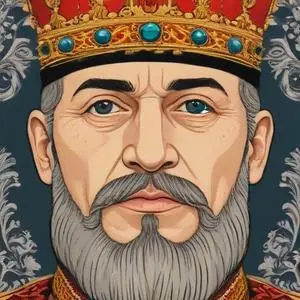
Unified Russia, ended Mongol rule, and established the Russian Orthodox Church as a major power.
Ivan III, also known as Ivan the Great, is renowned for transforming Russia into a centralized state, freeing it from Tatar domination, and establishing the foundations of the Moscow Kremlin. His 43-year reign from 1462 to 1505 marked a crucial period in Russian history, during which he consolidated power, expanded territories, and introduced significant legal and architectural reforms.
Born on January 22, 1440, Ivan III was the son of Vasily II, the Grand Prince of Moscow, and Maria of Borovsk. He was named heir and grand prince in treaties between his father and other Russian princes as early as 1448. Ivan's father, Vasily II, eventually blindsided his own brothers to secure the throne, instilling in Ivan a strong sense of ambition and strategic thinking.
Ivan III's reign was marked by a series of military campaigns, strategic alliances, and clever marriages that expanded Russia's territories. He annexed the principalities of Yaroslavl, Rostov, and Tver, and seized lands from his dynastic relatives. His victory over the Great Horde in 1480 formally restored Russia's independence, ending the Tatar yoke that had lasted for over two centuries.
To consolidate his power and establish a centralized state, Ivan III introduced a new legal code, improved administrative systems, and established a network of governors and local officials. He also created a professional army, which further strengthened his authority.
Ivan III commissioned the construction of the Moscow Kremlin, which became a symbol of Russian power and culture. He invited Italian architects to design and build the Kremlin's grandeur, introducing Renaissance styles to Russia. This cultural exchange also led to the adoption of the double-headed eagle as Russia's coat of arms.
Ivan III's marriage to Sophia Palaiologina, a niece of the last Byzantine Emperor, introduced him to the concept of Moscow as the "Third Rome." This ideology shaped his vision for Russia as a powerful, Orthodox state. Ivan III's 43-year reign was the second-longest in Russian history, and his legacy paved the way for his grandson, Ivan IV (also known as Ivan the Terrible).
Ivan III was the first Russian ruler to use the title "Tsar," although he used it tentatively until it was recognized by the Habsburgs. At home, he preferred the title of Grand Prince, but his correspondence with other monarchs demonstrated his ambition to be recognized as a sovereign equal.
Ivan III's legacy has had a profound impact on modern Russia. He established the foundations of the Russian state, created a centralized administration, and promoted Orthodox Christianity as the national religion. His vision for Moscow as the "Third Rome" continues to shape Russia's identity and influence its foreign policy.
Born in 1530
The first Tsar of Russia, who transformed the country into a multi-ethnic empire, known for his brutal suppression of opposition and creation of the Oprichnina, a personal bodyguard. He also established the Zemsky Sobor, a national assembly.
Born in 1672
Reformed Russia's government, military, and culture, transforming it into a major European power. Known for modernizing and westernizing the country through numerous reforms and founding St. Petersburg.
Born in 1729
Empress of Russia from 1762 to 1796, she transformed her country into a major European power, modernizing its culture, politics, and economy through numerous reforms and conquests.
Born in 1221
A 13th-century prince who defended Russia against foreign invasions and is revered as a saint in the Orthodox Church for his bravery and wisdom. He's also the subject of a famous Sergei Eisenstein film.
Born in 1479
Grand Prince of Moscow who consolidated power, annexed neighboring regions, and established the foundations for the Russian state, known for his centralizing policies and territorial expansion.
Born in 1479
Grand Prince of Moscow who consolidated power, annexed neighboring regions, and established the foundations for the Russian state, known for his centralizing policies and territorial expansion.
