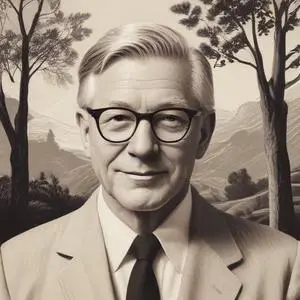
The Dean of Western Writers: Wallace Stegner
A Legendary Voice in American Literature
Wallace Stegner, often referred to as "The Dean of Western Writers," was a prolific American novelist, writer, environmentalist, and historian who left an indelible mark on the literary world. With a career spanning over five decades, Stegner was renowned for his poignant and evocative portrayals of the American West, earning him numerous accolades, including the Pulitzer Prize and the U.S. National Book Award.
Early Life and Influences
Born on February 18, 1909, in Lake Mills, Iowa, Stegner grew up in a peripatetic family, living in twenty different places across eight states and Canada. This nomadic childhood instilled in him a deep appreciation for the vast and diverse landscapes of the American West, which would later become a hallmark of his writing. Stegner's family eventually settled in Utah, where he developed a strong connection with the natural world and honed his writing skills.
Academic Pursuits and Literary Beginnings
Stegner's academic pursuits took him to the University of Utah, where he earned a B.A. in 1930. He later attended the University of Iowa, receiving a master's degree in 1932 and a doctorate in 1935. During his time at Iowa, Stegner was initiated into the Sigma Nu fraternity and began to develop his writing style, which would eventually earn him a reputation as one of the most celebrated Western writers.
Literary Career and Notable Works
Stegner's literary career was marked by a prolific output of novels, short stories, and essays that explored the complexities of the American West. Some of his most notable works include:
- Remembering Laughter (1973) - a novel that won the Pulitzer Prize for Fiction
- Angle of Repose (1971) - a novel that explores the marriage of a fictional couple and earned Stegner the U.S. National Book Award
- The Big Rock Candy Mountain (1938) - a novel that draws heavily from Stegner's childhood experiences in the American West
- Wolf Willow (1962) - a memoir that explores Stegner's childhood and his relationship with the natural world
Personal Life and Literary Partnership
In 1934, Stegner married Mary Stuart Page, with whom he shared a literary partnership that lasted for 59 years. Mary was an integral part of Stegner's writing process, serving as his editor, critic, and confidante. This partnership was described by Arthur Schlesinger Jr. as "a personal literary partnership of singular facility."
Activism and Environmentalism
Stegner was an ardent environmentalist and social activist, who was deeply concerned about the impact of human activity on the natural world. In the 1940s, he was a leading member of the Peninsula Housing Association, a group that aimed to build a cooperative housing complex for Stanford University faculty and staff. Stegner's environmental concerns are reflected in his writing, which often explores the complex relationships between humans and the natural world.
Legacy and Impact
Wallace Stegner's contributions to American literature are immeasurable. His writing has inspired generations of writers, including notable authors such as
Edward Abbey and
Annie Proulx. Stegner's legacy extends beyond the literary world, as his environmental activism and social advocacy have had a lasting impact on the way we think about the American West and our place within it.
Today, Stegner's work remains a testament to his boundless enthusiasm for the American West and his unwavering commitment to the craft of writing. As "The Dean of Western Writers," Stegner's influence will continue to be felt for generations to come.
FAQ
What was Wallace Stegners literary style?
Wallace Stegners literary style was characterized by his lyrical prose, nuanced characterizations, and exploration of the American West. His writing often blended fiction and nonfiction, creating a unique narrative voice.
What were Wallace Stegners most famous works?
Wallace Stegners most famous works include Angle of Repose, which won the Pulitzer Prize in 1972, and Beyond the Hundredth Meridian, a biography of John Wesley Powell. His writing often explored the American West, its history, and its people.
What was Wallace Stegners role in the environmental movement?
Wallace Stegner was a vocal advocate for environmental conservation and wilderness preservation. He played a key role in the establishment of several national parks and monuments, including the Glen Canyon National Recreation Area.
How did Wallace Stegners writing reflect his environmental concerns?
Wallace Stegners writing often reflected his concerns about the impact of human activity on the natural environment. His fiction and nonfiction works explored the tension between human settlement and the American wilderness.
What was Wallace Stegners legacy in American literature?
Wallace Stegners legacy in American literature is that of a masterful storyteller, environmental advocate, and explorer of the American West. His writing continues to inspire generations of writers, environmentalists, and readers.