


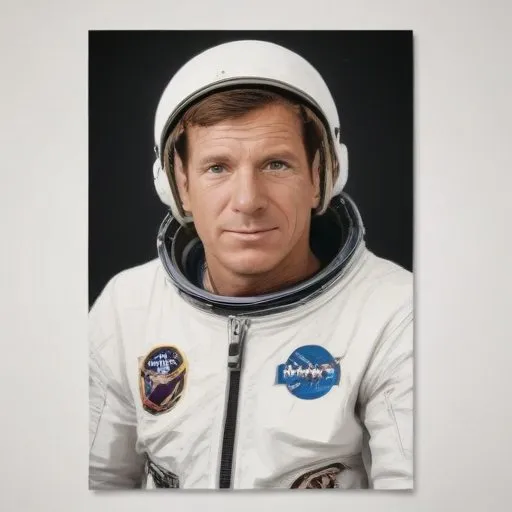
One of the original seven astronauts in Project Mercury, this pioneer flew on three historic spaceflights, including the first American manned orbital flight and the Apollo 7 mission.
Wally Schirra, a name synonymous with bravery, skill, and innovation, is one of the most celebrated astronauts in the history of space exploration. As one of the original seven astronauts chosen for Project Mercury, Schirra played a pivotal role in the United States' first effort to put humans into space, cementing his status as a pioneer in the field of astronautics.
Schirra was born on March 12, 1923, in Hackensack, New Jersey, to a family of aviators. His paternal grandparents were of Bavarian and Swiss descent, with roots tracing back to Sardinia. Growing up, Schirra was fascinated by aircraft and the thrill of flight, a passion that would eventually take him to unprecedented heights.
After graduating from the United States Naval Academy in 1945, Schirra served at sea during World War II. He then became a naval aviator in 1948, flying 90 combat missions in the Korean War. In 1958, he graduated from the U.S. Naval Test Pilot School, honing his skills as a test pilot and preparing himself for the challenges of space exploration.
Schirra's most notable achievements came as an astronaut in the Mercury, Gemini, and Apollo programs. On October 3, 1962, he flew the six-orbit, nine-hour Mercury-Atlas 8 mission, becoming the fifth American and ninth human to travel into space. In December 1965, as part of the two-man Gemini program, he achieved the first space rendezvous, station-keeping his Gemini 6A spacecraft within 1 foot of the sister Gemini 7 spacecraft. In October 1968, he commanded Apollo 7, an 11-day low Earth orbit shakedown test of the three-man Apollo Command-Service Module and the first crewed launch for the Apollo program.
Schirra was the first astronaut to go into space three times, and the only astronaut to have flown into space in the Mercury, Gemini, and Apollo programs. In total, he logged 295 hours and 15 minutes in space. After Apollo 7, he retired as a captain from the U.S. Navy as well as from NASA, subsequently becoming a consultant to CBS News in the network's coverage of following Apollo flights. Schirra joined Walter Cronkite as co-anchor for all seven of NASA's Moon landing missions.
Schirra was married to Jo Schirra for 47 years, and the couple had two children, Walter III and Suzanne. He was an avid sailor and enjoyed golf and reading in his free time. Schirra passed away on May 3, 2007, leaving behind a legacy that continues to inspire generations of space enthusiasts and scholars.
As we reflect on the life and achievements of Wally Schirra, we are reminded of the power of human ingenuity, determination, and collaboration. His courage and pioneering spirit paved the way for future generations of astronauts, scientists, and explorers, cementing his place in the annals of history as one of the most remarkable individuals of the 20th century.
Born in 1923
First American in space, commanded Apollo 14 mission, and walked on the Moon.
98 Years Old
American baseball player who pitched in the Major Leagues from 1965 to 1975, known for being a four-time All-Star and winning the American League ERA title in 1968.
Born in 1926
One of the original seven astronauts in NASA's Project Mercury, a decorated military pilot, and a pioneer in space exploration, known for being the second American in space and commanding the first manned Gemini mission.
99 Years Old
One of the original seven astronauts in Project Mercury, he was the first American to spend over a day in space and the last to fly solo in orbit, paving the way for future space exploration.
96 Years Old
Led the third manned mission to land on the Moon, Apollo 12, and became the third person to walk on its surface. Known for his bold and fearless approach to space exploration.
96 Years Old
First person to walk on the Moon during the Apollo 11 mission, marking a historic milestone in space exploration.
98 Years Old
Commander of the Apollo 13 mission, known for his heroic efforts in saving his crew after an explosion occurred on board. He's an iconic figure in space exploration history.
