


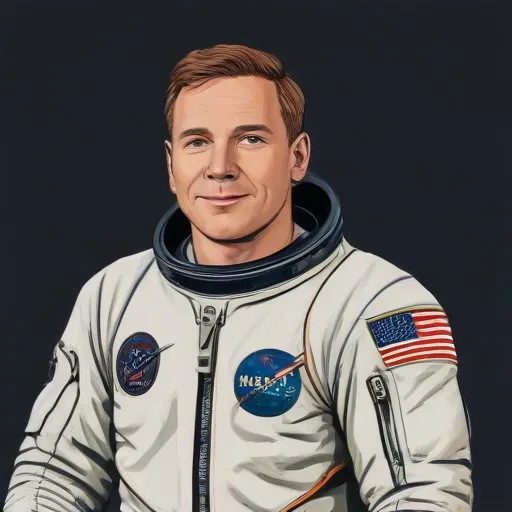
One of the last surviving astronauts from the early years of space exploration, known for being part of the Apollo 7 mission in 1968, the first manned Apollo flight.
Walter Cunningham, the American astronaut, fighter pilot, physicist, entrepreneur, venture capitalist, and author, is best known for being the lunar module pilot on the Apollo 7 mission in 1968, making him NASA's third civilian astronaut after Neil Armstrong and Elliot See. His remarkable journey to space marked a significant milestone in the history of space exploration.
Cunningham was born on March 16, 1932, in Creston, Iowa. He graduated from Venice High School in Los Angeles, California, in 1950, after which he attended Santa Monica College. His educational pursuits were put on hold when he joined the U.S. Navy in 1951, but he later resumed his studies, earning a Bachelor of Arts degree with honors in 1960 and a Master of Arts degree with distinction in 1961, both in physics, from the University of California, Los Angeles (UCLA).
Cunningham's military career spanned over two decades, during which he served as a fighter pilot with the U.S. Marine Corps from 1953 to 1956, flying 54 missions as a night fighter pilot in Korea. He later served in the United States Marine Corps Reserve from 1956 to 1975, eventually retiring at the rank of colonel.
In 1963, Cunningham was selected by NASA as an astronaut, and in 1968, he flew on the Apollo 7 mission, becoming the first astronaut to fly on a manned Apollo mission. This historic mission marked the first time humans had ventured into space since the Apollo 1 fire in 1967. Cunningham's contributions to the success of the mission were instrumental in paving the way for future manned spaceflights.
Cunningham was married to Lo Ella Irby, with whom he had two children, Brian and Kimberley. He later married Dorothy "Dot" Cunningham, a retired Houston businesswoman. Cunningham's legacy extends beyond his impressive career in space exploration; he was also a devoted husband, father, and author, having written the 1977 book "The All-American Boys."
Despite his many accomplishments, Cunningham faced controversy during his NASA career, particularly with regards to his criticism of the agency's management and safety protocols. However, his bravery and commitment to space exploration earned him a place in the hearts of many Americans, cementing his status as a national hero.
"We were not just astronauts, we were test pilots... We were trying to find out what the plane would do, and that's exactly what we did on Apollo 7." - Walter Cunningham
Cunningham's contributions to space exploration have had a lasting impact on modern society, inspiring generations of scientists, engineers, and astronauts. His bravery and pioneering spirit have paved the way for continued advancements in space travel and exploration.
Walter Cunningham's legacy extends beyond his remarkable achievements in space exploration. He played a crucial role in shaping the course of American history, demonstrating the nation's commitment to space exploration and its potential for human advancement. Cunningham's life and career serve as a testament to the power of human ingenuity, courage, and determination.
96 Years Old
First person to walk on the Moon during the Apollo 11 mission, marking a historic milestone in space exploration.
96 Years Old
Second man to walk on the Moon during the Apollo 11 mission, a pioneering astronaut and advocate for space exploration.
96 Years Old
Led the third manned mission to land on the Moon, Apollo 12, and became the third person to walk on its surface. Known for his bold and fearless approach to space exploration.
94 Years Old
One of the 12 humans to walk on the Moon during NASA's Apollo program, known for his moonwalk during Apollo 12 and later becoming a painter, capturing the beauty of space through art.
Born in 1921
A renowned surgeon who wrote bestselling novels, including "Doctor in the House," which was adapted into a successful film and TV series, offering a humorous glimpse into medical life.
95 Years Old
Pilot, engineer, and astronaut who flew on four NASA spaceflights, including the Apollo-Soyuz Test Project, the first joint US-Soviet space mission. He was also a test pilot and held several records for altitude and speed.
95 Years Old
Astronaut and pilot who flew on Apollo 13, famously uttering "Houston, we've had a problem" during the mission's critical malfunction. He played a crucial role in saving the crew from disaster.
92 Years Old
Astronaut and engineer who flew on the Apollo 13 mission, known for his bravery and ingenuity during the mission's critical failure. He also flew on the Enterprise during the Approach and Landing Tests.
