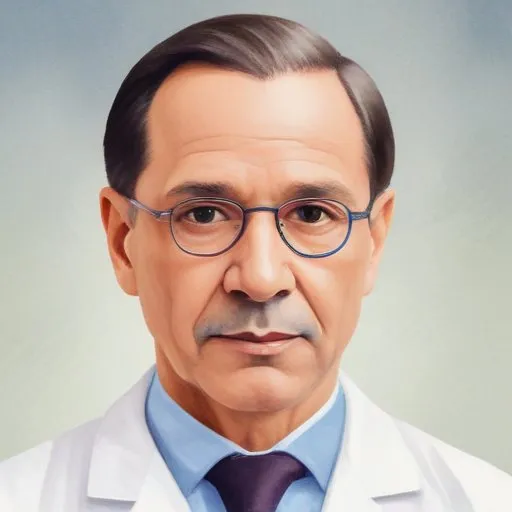
Walter Jackson Freeman II: The Controversial Pioneer of Lobotomy
Walter Jackson Freeman II was a American physician who specialized in lobotomy, a procedure that involved severing or scraping away parts of the brain to alleviate mental illnesses. He is known for inventing the transorbital lobotomy procedure, also known as the "icepick lobotomy," which simplified the process and made it more accessible to psychiatrists.
A Simplified Approach to Lobotomy
Freeman's transorbital lobotomy method did not require a neurosurgeon and could be performed outside of an operating room, often by untrained psychiatrists without the use of anesthesia. This approach was met with both amazement and horror, as it seemed to offer a quick fix for mental illnesses, but also raised serious ethical concerns.
A Pioneering Career
Freeman's interest in psychology and neurology began during his time at the University of Pennsylvania, where he earned his medical degree in 1918. He went on to work at various institutions, including the Washington D.C. Veterans Affairs Hospital, where he developed his lobotomy procedure.
The Rise of Lobotomy
Freeman's procedure gained popularity in the 1940s and 1950s, with many psychiatrists and mental institutions adopting it as a treatment for schizophrenia, depression, and other mental illnesses. Freeman himself performed thousands of lobotomies, traveling across the United States to mental institutions and promoting his procedure.
A Controversial Legacy
However, Freeman's method was not without its critics. Many argued that it was inhumane, and that it did more harm than good to patients. The procedure was often performed without proper training or anesthesia, leading to complications and even death. Freeman's partner, Dr. James W. Watts, ended their partnership in 1947 due to his disgust with Freeman's approach.
A Tragic Incident
In 1951, one of Freeman's patients died during a procedure, when he suddenly stopped for a photo, and the orbitoclast accidentally penetrated too far into the patient's brain. This incident sparked further criticism of Freeman's method, and his reputation began to decline.
Later Life and Ban
Freeman continued to perform lobotomies until 1967, when he was finally banned from performing surgery. Despite the controversy surrounding his work, Freeman remained dedicated to his craft, and continued to promote his procedure until his death in 1972.
Impact on Modern Society
Freeman's work had a significant impact on modern society, raising important questions about the ethics of medical experimentation and the treatment of mental illness. His procedure may have been flawed, but it sparked a necessary conversation about the need for more humane and effective treatments.
Philosophical Contributions and Beliefs
Freeman's work was motivated by a belief in the importance of treating mental illness, and a desire to find a quick and effective solution. While his approach may have been misguided, it reflects a deeper commitment to understanding and alleviating human suffering.
Personal Milestones and Key Life Events
- Born on November 14, 1895, in Philadelphia, Pennsylvania
- Earned medical degree from the University of Pennsylvania in 1918
- Developed the transorbital lobotomy procedure in the 1930s
- Performed thousands of lobotomies across the United States
- Banned from performing surgery in 1967
- Died on May 31, 1972
Trivia and Fun Facts
- Freeman's grandfather, William Williams Keen, was a renowned surgeon.
- Freeman's transorbital lobotomy procedure was sometimes referred to as the "icepick lobotomy."
- Freeman's work on lobotomy was featured in the novel and film "One Flew Over the Cuckoo's Nest."
Historical Context and Legacy
Freeman's work on lobotomy reflects a darker period in the history of psychiatry, when treatments were often experimental and untested. While his approach may have been flawed, it serves as a reminder of the need for continued research and innovation in the field of mental health.
FAQ
What was Walter Jackson Freeman IIs contribution to the field of psychiatry?
Walter Jackson Freeman II was a prominent American psychiatrist who made significant contributions to the field, including the development of the transorbital lobotomy, a controversial procedure used to treat mental illnesses.
How did Walter Jackson Freeman IIs work influence the treatment of mental illness?
Walter Jackson Freeman IIs work on the transorbital lobotomy, although later criticized, marked a significant shift in the treatment of mental illnesses, moving away from institutionalization and towards more radical, surgical interventions.
What was Walter Jackson Freeman IIs view on the role of psychiatry in society?
Walter Jackson Freeman II believed that psychiatry played a critical role in addressing societal ills, such as crime and delinquency, by treating underlying mental health issues. He advocated for a more holistic approach to mental health care.
How did Walter Jackson Freeman IIs work impact the development of modern psychiatry?
Walter Jackson Freeman IIs work, while controversial, contributed to the development of modern psychiatry, driving innovation and debate in the field. His legacy continues to inspire new generations of psychiatrists and researchers.
What is Walter Jackson Freeman IIs legacy in the history of psychiatry?
Walter Jackson Freeman IIs legacy in the history of psychiatry is complex, marked by both significant contributions and controversy. His work remains an important chapter in the evolution of psychiatric thought and practice.