


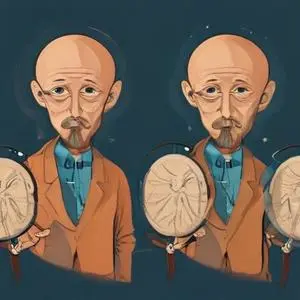
Pioneering neuroscientist and pathologist who discovered the structure of neurons and pioneered the field of neuroscience, earning a Nobel Prize in Physiology or Medicine in 1906.
Santiago Ramón y Cajal, a Spanish neuroscientist, pathologist, and histologist, revolutionized our understanding of the human brain with his groundbreaking discoveries on the microscopic structure of the central nervous system. His pioneering work earned him the Nobel Prize in Physiology or Medicine in 1906, making him the first person of Spanish origin to receive this prestigious award.
Ramón y Cajal was born on May 1, 1852, in Petilla de Aragón, Navarre, Spain. As a child, he was known for his rebellious and antiauthoritarian attitude, which often led to him being transferred from one school to another. However, these traits would later serve him well in his pursuit of scientific discovery.
His father, a anatomy teacher, recognized his son's artistic talents, but instead of nurturing them, he apprenticed Ramón y Cajal to a shoemaker and barber to instill discipline and stability. However, it was during these early years that Ramón y Cajal developed a passion for painting and gymnastics, skills that would later aid him in his scientific illustrations.
During the summer of 1868, Ramón y Cajal's father took him to graveyards to collect human remains for anatomical study. This experience sparked his interest in medical studies, and he went on to attend the medical school of the University of Zaragoza, where his father worked.
He graduated in 1873, aged 21, and then served as a medical officer in the Spanish Army. It was during his time in Cuba (1874-1875) that he contracted malaria and tuberculosis, which led to a period of recovery in the spa town of Panticosa.
Ramón y Cajal's fascination with the human brain led him to investigate its microscopic structure. Using a technique called Golgi's stain, he discovered the existence of neuron cells and their complex tree-like branching patterns, known as arborizations.
His original drawings of brain cells, created using a combination of art and science, are still used today for educational and training purposes. These illustrations not only showcased his artistic talent but also provided a visual representation of the brain's intricate structure, making him a pioneer of modern neuroscience.
In 1906, Ramón y Cajal was awarded the Nobel Prize in Physiology or Medicine, alongside Camillo Golgi, for his work on the structure of the nervous system. This recognition cemented his status as a pioneer in the field of neuroscience.
Today, Ramón y Cajal's legacy extends beyond his scientific contributions. His work has inspired generations of neuroscientists, and his artistic talent has encouraged others to explore the intersection of art and science.
"Every man can, if he so desires, become the sculptor of his own brain."
Ramón y Cajal's legacy serves as a testament to the power of human curiosity and the importance of embracing our individuality. His work has left an indelible mark on the field of neuroscience, and his story continues to inspire future generations of scientists and artists alike.
Born in 1843
Italian physician and pathologist who discovered the Golgi apparatus, a complex organelle found in cells, and developed a staining technique to visualize it. His work revolutionized the field of cell biology.
Born in 1857
A pioneering scientist who made groundbreaking discoveries in the fields of physiology, bacteriology, and pathology, and was awarded the Nobel Prize for his work on the nervous system.
Born in 1875
A pioneering researcher who discovered the chemical neurotransmitter acetylcholine and its role in the nervous system, revolutionizing our understanding of nerve impulses and muscle contractions.
Born in 1873
A pioneering scientist who discovered the chemical transmission of nerve impulses, revolutionizing our understanding of the nervous system. His groundbreaking work earned him a Nobel Prize in Physiology or Medicine in 1936.
Born in 1879
A brilliant physicist who developed the theory of relativity and is considered one of the most influential scientists of the 20th century, known for his groundbreaking work in physics and mathematics.
Born in 1867
A pioneering scientist who pioneered radioactivity research, discovering elements polonium and radium, and paving the way for breakthroughs in medicine and energy.
Born in 1859
A pioneer in radioactivity research, discovering elements like polonium and radium, and pioneering radioactive isolation techniques. Their groundbreaking work paved the way for advancements in medicine, energy, and materials science.
Born in 1849
A Russian physiologist and physician who discovered the concept of classical conditioning, where he demonstrated that animals can learn to associate stimuli with a particular response, revolutionizing our understanding of behavior. His work laid the foundation for behavioral psychology and continues to influence fields like education and advertising.
