


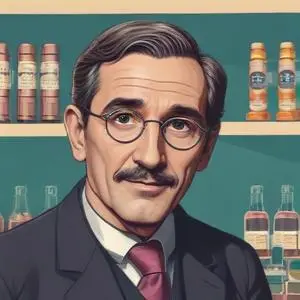
A pioneering scientist who made groundbreaking discoveries in the fields of physiology, bacteriology, and pathology, and was awarded the Nobel Prize for his work on the nervous system.
Sir Charles Scott Sherrington is renowned for his groundbreaking contributions to the field of neuroscience, particularly in the discovery of the spinal reflex as a system involving connected neurons, and the concept of the synapse, which he coined to describe the connection between two neurons. His work has had a profound impact on our understanding of the nervous system, earning him the Nobel Prize in Physiology or Medicine in 1932.
Sherrington was born on November 27, 1857, in Islington, London, England, to James Norton Sherrington, an ironmonger and artist's colourman, and his wife, Anne Thurtell. After his father's death in 1848, Sherrington was raised by his mother and Caleb Rose, a surgeon, in Ipswich. He was educated at Ipswich School and later at Gonville and Caius College, Cambridge, where he studied medicine.
Sherrington's research focused on the nervous system, and his work led to significant discoveries that transformed the field of neuroscience. His book, The Integrative Action of the Nervous System (1906), is a seminal work that synthesizes his research on the nervous system. In this work, he introduced the concept of the synapse, which revolutionized our understanding of neural communication.
He also studied the spinal reflex, demonstrating that it is a system involving connected neurons. His work on the neuron doctrine, which posits that the nervous system is composed of individual neurons that communicate with each other, laid the foundation for modern neuroscience.
In recognition of his outstanding contributions to physiology, Sherrington was awarded the Nobel Prize in Physiology or Medicine in 1932, along with Edgar Adrian. He was also elected as a Fellow of the Royal Society in 1893 and served as its president from 1920 to 1925.
Sherrington's work has had a profound impact on our understanding of the nervous system and has led to significant advances in the treatment of neurological disorders. His discovery of the synapse has enabled the development of new therapies for conditions such as Parkinson's disease and Alzheimer's disease.
In addition, his work has inspired generations of neuroscientists, paved the way for new areas of research, and continues to influence the development of neurology and neuroscience today.
Sherrington married Ethel Mary Wright in 1892, and the couple had one son, Carr Sherrington. He died on March 4, 1952, at the age of 94, leaving behind a legacy of groundbreaking research and a profound impact on the field of neuroscience.
Sherrington's work has stood the test of time, and his discoveries continue to shape our understanding of the nervous system. His legacy extends beyond his scientific contributions, as he has inspired generations of scientists and continues to influence the development of neuroscience today.
In the context of his time, Sherrington's work was a significant departure from the traditional view of the nervous system as a single, unified entity. His discovery of the synapse and the neuron doctrine challenged this view and paved the way for a new understanding of the nervous system as a complex, interconnected system.
"The synapse is the crucial element in the nervous system, for it is here that the activity of one neuron is communicated to another."
"The nervous system is not a single entity, but a complex system of interconnected neurons."
These quotes capture the essence of Sherrington's work and highlight the significance of his discoveries.
Sherrington's work was contemporaneous with that of other prominent neuroscientists, such as Santiago Ramón y Cajal and Camillo Golgi. While these scientists made significant contributions to the field of neuroscience, Sherrington's work stands out for its focus on the synapse and the neuron doctrine, which has had a profound and lasting impact on our understanding of the nervous system.
Sherrington was known for his humble and unassuming nature, which earned him the respect and admiration of his colleagues. Despite his significant contributions to the field of neuroscience, he remained humble and dedicated to his work, inspiring generations of scientists.
Sherrington was dedicated to his work and made significant contributions to the field of neuroscience. While he did not engage in direct charitable work, his legacy continues to inspire and advance the field of neuroscience, improving our understanding of the nervous system and contributing to the development of new treatments for neurological disorders.
Born in 1903
A Nobel Prize-winning neurophysiologist who discovered the chemical synaptic transmission of nerve impulses, revolutionizing our understanding of the human brain. His work has had a profound impact on the field of neuroscience.
Born in 1917
A Nobel Prize-winning physiologist and biophysicist who uncovered the mechanisms of nerve impulses, revolutionizing our understanding of the human body's electrical signals.
Born in 1916
Pioneering scientist who discovered the structure of DNA, revolutionizing our understanding of genetics and life itself.
98 Years Old
Discovered the structure of DNA, revolutionizing our understanding of genetics and earning a Nobel Prize. Pioneering work in molecular biology has far-reaching implications for medicine and beyond.
Born in 1920
A British scientist who contributed significantly to the discovery of the structure of DNA, providing high-quality X-ray crystallography images that helped James Watson and Francis Crick develop their famous model.
Born in 1916
A Nobel Prize-winning physicist and biologist who contributed significantly to the discovery of the structure of DNA, using X-ray crystallography to produce the first clear images of the molecule.
Born in 1852
Pioneering neuroscientist and pathologist who discovered the structure of neurons and pioneered the field of neuroscience, earning a Nobel Prize in Physiology or Medicine in 1906.
