


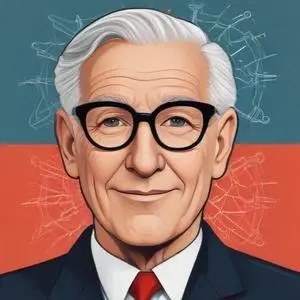
A Nobel Prize-winning neurophysiologist who discovered the chemical synaptic transmission of nerve impulses, revolutionizing our understanding of the human brain. His work has had a profound impact on the field of neuroscience.
Sir John Carew Eccles, a renowned Australian neurophysiologist and philosopher, is best known for his groundbreaking work on the synapse, which earned him the esteemed Nobel Prize in Physiology or Medicine in 1963. Alongside Andrew Huxley and Alan Lloyd Hodgkin, Eccles' pioneering research laid the foundation for modern understanding of the neural transmission process.
Born on January 27, 1903, in Melbourne, Australia, Eccles was raised by his parents, William and Mary Carew Eccles, both teachers, who homeschooled him until the age of 12. He then attended Warrnambool High School and later completed his final year of schooling at Melbourne High School. Aged 17, Eccles received a senior scholarship to study medicine at the University of Melbourne, where he graduated with first-class honors in 1925.
Eccles' fascination with the mind-body interaction led him to pursue a Doctor of Philosophy at Magdalen College, Oxford University, under the guidance of Charles Scott Sherrington. He received his Ph.D. in 1929. Upon returning to Australia in 1937, Eccles worked on military research during World War II and later became the director of the Kanematsu Institute at Sydney Medical School. His research lectures at the University of Sydney, alongside Bernard Katz, significantly influenced the intellectual environment of the institution.
Eccles' most notable research, conducted in the early 1950s, led to his Nobel Prize win in 1963. His work on the synapse and neural transmission process has had a lasting impact on the field of neurophysiology.
Eccles' philosophical inclinations led him to explore the mind-body problem, where he proposed the concept of "dualist-interactionism." This idea posits that the mind and body are separate entities that interact with each other, rather than being a single, monistic entity. Eccles' work in this area has had significant implications for the fields of philosophy and neuroscience.
Sir John Carew Eccles' pioneering work has had a profound impact on modern neuroscience and philosophy. His research has paved the way for significant advancements in our understanding of the neural transmission process and has opened up new avenues for exploration in the fields of neuroscience and philosophy.
Eccles' legacy extends beyond his scientific contributions, as his philosophical ideas continue to influence contemporary debates on the mind-body problem. His work serves as a testament to the power of interdisciplinary research and the importance of exploring the complexities of the human experience.
Sir John Carew Eccles' remarkable life and career serve as a testament to the power of dedication, perseverance, and interdisciplinary research. His work continues to inspire and influence scholars across the globe, cementing his legacy as a true pioneer in the fields of neurophysiology and philosophy.
Born in 1917
A Nobel Prize-winning physiologist and biophysicist who uncovered the mechanisms of nerve impulses, revolutionizing our understanding of the human body's electrical signals.
Born in 1911
A German-English biophysicist who discovered the neurotransmitter acetylcholine and its role in transmitting nerve impulses, leading to a deeper understanding of the nervous system.
Born in 1857
A pioneering scientist who made groundbreaking discoveries in the fields of physiology, bacteriology, and pathology, and was awarded the Nobel Prize for his work on the nervous system.
Born in 1891
A pioneering neurosurgeon who mapped the brain's sensory and motor areas, leading to significant advances in epilepsy treatment and our understanding of the brain's functions.
Born in 1926
A Nobel Prize-winning neurophysiologist who uncovered the inner workings of the visual cortex, revealing how the brain processes visual information. Their groundbreaking research revolutionized our understanding of the human brain.
Born in 1924
A Swedish neurophysiologist and academic who discovered the organization and function of the visual cortex, and was awarded the Nobel Prize in Physiology or Medicine in 1981 for his work on the brain's visual system.
