


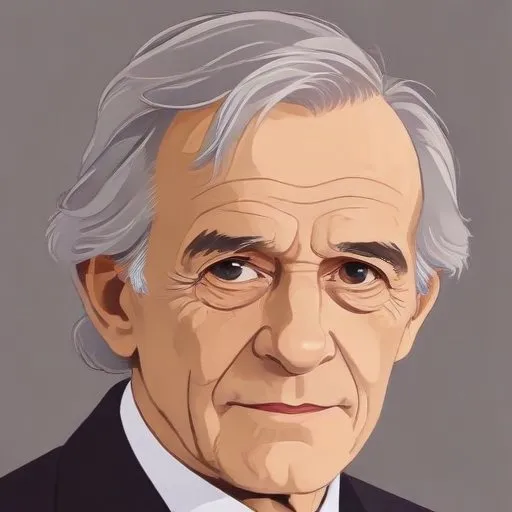
A Swedish neurophysiologist and academic who discovered the organization and function of the visual cortex, and was awarded the Nobel Prize in Physiology or Medicine in 1981 for his work on the brain's visual system.
Torsten Wiesel, the renowned Swedish neurophysiologist, is one of the most celebrated scientists of the 20th century, best known for his groundbreaking discoveries on information processing in the visual system, which earned him the 1981 Nobel Prize in Physiology or Medicine, alongside David H. Hubel.
Born on June 3, 1924, in Uppsala, Sweden, Wiesel was the youngest of five children. He began his scientific career in 1947 at the Karolinska Institute, where he worked in Carl Gustaf Bernhard's laboratory and received his medical degree in 1954.
In 1955, Wiesel moved to the United States to work at Johns Hopkins School of Medicine under Stephen Kuffler. It was here that he began a fellowship in ophthalmology and met his future research partner, David Hubel, in 1958. This collaboration would last over twenty years, during which they made seminal contributions to our understanding of the visual system.
In 1959, Wiesel and Hubel moved to Harvard University, where Wiesel became an instructor in pharmacology at Harvard Medical School. Over the next two decades, he rose through the ranks, becoming a professor in the department of neurobiology in 1968 and its chair in 1973.
In 1983, Wiesel joined Rockefeller University as Vincent and Brooke Astor Professor and head of the Laboratory of Neurobiology. He later served as president of the university from 1991 to 1998 and remains codirector of the Shelby White and Leon Levy Center for Mind, Brain and Behavior.
Wiesel's influence extends beyond academia. He served as Secretary-General of the Human Frontier Science Program from 2000 to 2009, promoting international collaboration in life sciences research.
He has also chaired the scientific advisory board of China's National Institute of Biological Science (NIBS) in Beijing and cochaired the board of governors of the Okinawa Institute of Science and Technology.
In addition to the Nobel Prize, Wiesel has received numerous awards and honors for his contributions to neuroscience, including the Louisa Gross Horwitz Prize, the National Medal of Science, and the Albert Lasker Award.
Torsten Wiesel's work has left an indelible mark on our understanding of the visual system and its development. His discoveries have paved the way for further research into neurological disorders, visual perception, and brain development. As a leader in the scientific community, he has inspired generations of researchers to pursue careers in neuroscience.
Through his tireless efforts to promote international collaboration and interdisciplinary research, Wiesel has helped shape the course of scientific inquiry, leaving behind a legacy that will continue to inspire and inform future generations of scientists.
Born in 1926
A Nobel Prize-winning neurophysiologist who uncovered the inner workings of the visual cortex, revealing how the brain processes visual information. Their groundbreaking research revolutionized our understanding of the human brain.
96 Years Old
A pioneering neuroscientist and psychiatrist who unraveled the mysteries of memory and learning, earning a Nobel Prize for his groundbreaking work on the physiological basis of memory storage.
Born in 1923
A Swedish pharmacologist and physician who discovered the neurotransmitter dopamine's role in the brain, leading to major breakthroughs in Parkinson's disease treatment.
93 Years Old
A renowned neurologist and author who explored the human brain's mysteries through captivating storytelling, making complex medical concepts accessible to a broad audience.
Born in 1916
Pioneering scientist who discovered the structure of DNA, revolutionizing our understanding of genetics and life itself.
98 Years Old
Discovered the structure of DNA, revolutionizing our understanding of genetics and earning a Nobel Prize. Pioneering work in molecular biology has far-reaching implications for medicine and beyond.
79 Years Old
A renowned biologist and geneticist who discovered the genetic control of embryonic development, earning a Nobel Prize in Physiology or Medicine in 1995. Their work has greatly advanced our understanding of developmental biology and its applications.
