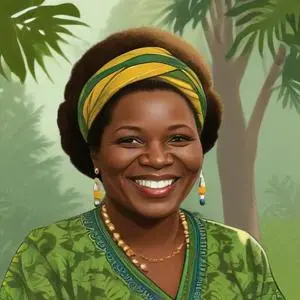
Wangari Maathai: The Green Crusader
Tree Planting Pioneer and Nobel Laureate
Wangari Maathai is renowned for being the first African woman to receive the Nobel Peace Prize in 2004, recognized for her groundbreaking work in environmental conservation and sustainable development. Her iconic tree-planting initiative, the Green Belt Movement, has empowered communities to take charge of their environment, promoting peace, democracy, and women's rights.
The Early Years
Born on April 1, 1940, in Nyeri, Kenya, Wangari grew up in a farming family and was raised with a deep appreciation for nature. She pursued higher education in the United States, earning a degree in biology from Mount St. Scholastica College in 1964. Wangari later returned to Kenya, where she became the first woman in East and Central Africa to earn a Ph.D. in veterinary anatomy in 1971.
The Green Belt Movement
In the 1970s, Wangari observed the devastating impact of environmental degradation on rural communities in Kenya. She identified tree planting as a simple yet effective solution to address soil erosion, deforestation, and poverty. The Green Belt Movement, launched in 1977, encouraged Kenyan women to take charge of their environment by planting trees, promoting sustainable livelihoods, and advocating for their rights.
Philosophical Contributions and Beliefs
Wangari's work embodied a profound philosophy: that the environment, democracy, and human well-being are inextricably linked. She believed that by empowering local communities, especially women, to care for their environment, they would become engaged citizens, promoting peaceful and sustainable development.
Career Highlights and Major Works
- Founded the Green Belt Movement in 1977
- Assisted in the establishment of the Pan African Consultative Conference on the Environment in 1985
- Published numerous articles and books, including The Green Belt Movement: Sharing the Approach and the Experience (1985)
- Served as the Chair of the National Council of Women of Kenya (1981-1987)
- Appointed as the Assistant Minister for Environment and Natural Resources in 2003
Influence on Modern Society
Wangari Maathai's work has inspired a global movement, demonstrating the power of grassroots environmental activism. Her legacy extends beyond Kenya, influencing environmental policies and sustainable development initiatives worldwide.
Personal Milestones and Key Life Events
- Married Mwangi Mathai in 1969, with whom she had three children
- Survived imprisonment and harassment for her environmental activism in the 1990s
- Received the Nobel Peace Prize in 2004
- Passed away on September 25, 2011, leaving behind a lasting impact on the environment and human rights
Quotes and Memorable Sayings
- "You cannot protect the environment unless you empower people, you inform them, and you help them understand that these resources are their own, that they must protect them."
- "We need to promote the idea that the environment is a shared resource, and we need to take care of it."
Historical Context and Legacy
Wangari Maathai's remarkable journey serves as a testament to the power of grassroots activism, women's empowerment, and environmental stewardship. Her work continues to inspire future generations to prioritize the health of our planet and its inhabitants.
Charitable Work and Social Contributions
The Wangari Maathai Institute for Peace and Environmental Studies, established in 2012, perpetuates her vision by promoting sustainable development, peace, and environmental conservation.
Inspirational Stories and Motivations
Wangari Maathai's unwavering dedication to her cause, despite numerous challenges, serves as a beacon of inspiration for anyone passionate about creating positive change. Her story demonstrates that even the smallest actions can spark a global movement, empowering individuals to become champions of environmental conservation and social justice.
FAQ
What is Wangari Maathais most notable achievement ?
Wangari Maathai is the first African woman to win the Nobel Peace Prize, which she received in 2004 for her contributions to sustainable development, democracy, and peace. Her work on environmental conservation and womens empowerment has inspired millions around the world.
How did Wangari Maathais early life influence her environmental activism?
Maathais childhood in rural Kenya instilled in her a deep appreciation for nature and the importance of preserving the environment. Her experiences as a woman in a patriarchal society also shaped her commitment to empowering women and promoting social justice.
What is the Green Belt Movement, and how did Wangari Maathai contribute to it?
The Green Belt Movement is a grassroots environmental organization that empowers communities to take charge of their environment and promotes sustainable development. Maathai founded the movement in 1977 and led it until her death in 2011, during which time millions of trees were planted and communities across Africa were empowered.
How did Wangari Maathais work impact Kenyas environmental policy?
Maathais tireless advocacy for environmental protection led to significant changes in Kenyas environmental policy. She played a key role in the development of the countrys national environmental policy and was a vocal critic of government policies that harmed the environment.
What is Wangari Maathais legacy in the environmental movement?
Maathais legacy in the environmental movement is that of a courageous and visionary leader who inspired a generation of environmentalists and social activists. Her work continues to inspire people around the world to take action to protect the environment and promote social justice.