


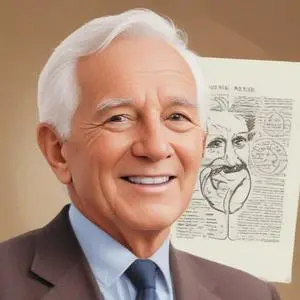
A renowned leadership expert and prolific author, known for his groundbreaking work on organizational development and leadership theory. He wrote over 30 books on leadership and management, influencing generations of business leaders and scholars.
Warren Gamaliel Bennis, widely regarded as a pioneer of the contemporary field of leadership studies, left an indelible mark on the world of organizational management and beyond. Through his groundbreaking work, Bennis challenged traditional notions of leadership, paving the way for a more democratic, adaptive, and humanistic approach to management.
Bennis was born on March 8, 1925, in the Bronx, New York, to a working-class Jewish family. He grew up in Westwood, New Jersey, and enlisted in the United States Army in 1943, where he served as one of the Army's youngest infantry officers in the European theater of operations. During his military service, Bennis was awarded the Purple Heart and Bronze Star.
Following his military service, Bennis enrolled in Antioch College in 1947, where he earned his BA in 1951. He went on to receive an Honors Certificate from the London School of Economics in 1952 and was awarded a Hicks Fellow from MIT.
Bennis's work at MIT in the 1960s on group behavior foreshadowed and helped bring about today's less hierarchical, more democratic, and adaptive institutions, private and public. His Revisionist Theory of Leadership, published in the Harvard Business Review in 1961, challenged the prevailing wisdom and established him as a pioneer in the field of leadership studies.
Bennis held various academic positions throughout his career, including University Professor and Distinguished Professor of Business Administration at the University of Southern California. He was also the Founding Chairman of The Leadership Institute at USC. His work spanned multiple disciplines, including organizational behavior, psychology, and philosophy, cementing his reputation as a true polymath.
Bennis's work has had a profound impact on modern society, shaping the way we think about leadership and management. His emphasis on democratic, humanistic, and adaptive leadership has influenced generations of scholars, practitioners, and policymakers. As management expert Tom Peters wrote, "Warren Bennis's work has brought about a headlong plunge into less hierarchical, more democratic, and adaptive institutions, private and public."
Bennis's work was guided by a deep commitment to democratic values and a belief in the importance of human relationships in organizational settings. He argued that leaders must be capable of nurturing and empowering others, rather than simply exercising power and control.
"Leadership is the capacity to translate vision into reality."
Warren Bennis's life and work serve as a testament to the power of vision, creativity, and collaboration. Through his pioneering work, he has left a lasting legacy that continues to inspire and shape the world of leadership studies.
Warren Bennis's life and work can be visualized through the following milestones:
Born in 1909
A renowned management guru, known for pioneering modern management practices and authoring influential books on business and society.
Born in 1908
Developed the Hierarchy of Needs, a pyramid-shaped model that prioritizes human needs, from basic physiological needs to self-actualization and personal growth. His work focuses on human motivation and the pursuit of happiness.
Born in 1916
A pioneer in artificial intelligence, decision-making, and problem-solving, he's renowned for his work on bounded rationality and the concept of satisficing.
83 Years Old
A renowned management guru and bestselling author, known for championing excellence and innovation in business, inspiring entrepreneurs and leaders worldwide.
