


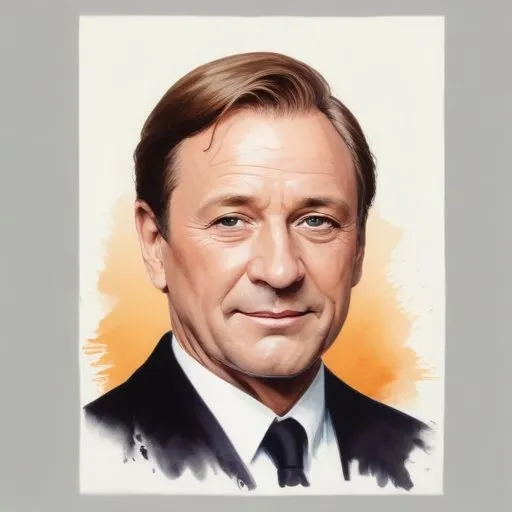
A pioneering opera director and producer, known for revolutionizing the art form with his innovative and minimalist stagings of Richard Wagner's operas.
Wieland Wagner, the celebrated German opera director, is renowned for revolutionizing the world of opera with his innovative and modern approach to staging. As the grandson of Richard Wagner, he boldly departed from traditional naturalistic scenery and lighting, instead infusing his productions with symbolic and psychological depth.
Wieland Wagner was born on January 5, 1917, to Siegfried and Winifred Wagner, and was the great-grandson of composer Franz Liszt through his paternal grandmother. His family's rich musical heritage laid the foundation for his future endeavors in the world of opera. In 1941, he married dancer and choreographer Gertrud Reissinger, with whom he had four children: Iris, Wolf Siegfried, Nike, and Daphne.
Wieland's directorial career began before World War II, where he worked on operas by his father and grandfather. However, it wasn't until after the war that his innovative approach truly emerged. As co-director of the Bayreuth Festival, which reopened in 1951, Wieland introduced a modernist style that focused on the psychology of the drama, rather than naturalistic scenery and lighting. This bold shift in approach sparked intense debates and reactions from critics and audiences alike.
Wieland's groundbreaking productions include his 1951 staging of Parsifal, which featured film projections during the transformation scenes, and his 1955 production of Tristan und Isolde, which introduced a new level of intimacy and emotional depth to the opera. His collaborations with notable singers, such as Anja Silja, further solidified his reputation as a visionary director.
In 1965, Wieland was awarded the prestigious Pour le Mérite, a testament to his contributions to the world of opera. His impact on the art form was further recognized when he was posthumously inducted into the German Hall of Fame in 2007.
Wieland's personal life was marked by a love affair with singer Anja Silja, as well as his marriage to Gertrud Reissinger, which ended in divorce. His untimely death from lung cancer on October 17, 1966, at the age of 49, cut short a brilliant career that had only just begun to flourish. Despite his passing, Wieland's legacy continues to inspire and influence opera directors to this day, cementing his place as a true innovator in the world of opera.
Wieland's philosophy on opera was aptly summed up in his own words: "The drama is not on the stage, but in the souls of the characters." This quote encapsulates his commitment to exploring the psychological depths of opera, rather than mere spectacle.
Wieland's pioneering work paved the way for the development of Regietheater, a modern approach to opera that focuses on the director's interpretation of the drama. His influence can be seen in the work of contemporary directors, such as Peter Brook and Patrice Chéreau, who continue to push the boundaries of opera as an art form.
Born in 1813
A revolutionary composer who transformed opera with his epic, mythological works, creating a new era of musical storytelling. His iconic operas, such as "Der Ring des Nibelungen," continue to captivate audiences worldwide.
Born in 1786
The King of Bavaria who commissioned the iconic Neuschwanstein Castle, a fairytale-like palace that inspired the Disney castle, and was a patron of the arts, supporting Richard Wagner's operas.
86 Years Old
A pioneer of modern dance, she revolutionized the art form with emotionally charged, often provocative performances that explored the human condition. Her work continues to inspire and influence dancers, choreographers, and artists worldwide.
97 Years Old
A German poet, playwright, and director who redefined the boundaries of avant-garde theatre, blending poetry and drama to create a unique, provocative, and influential style. His works continue to inspire and challenge audiences worldwide.
82 Years Old
A French artistic visionary who brought complex, provocative stories to life through film, theater, and opera, earning international acclaim for his bold, emotionally charged productions.
