


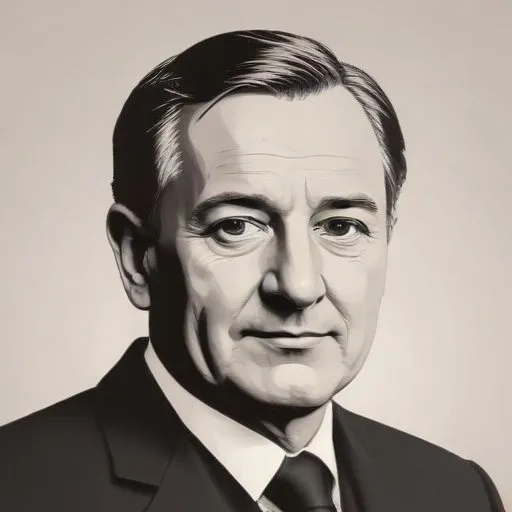
The 60th Prime Minister of Belgium, a Christian democrat who served six times as prime minister, known for his efforts to strengthen the European Union and his role in shaping Belgium's federal state.
Wilfried Martens, a Belgian politician, is renowned for his pivotal role in transforming Belgium into a federal state during his premiership from 1979 to 1981 and again from 1981 to 1992. As a key figure in the Flemish Christian People's Party, Martens played a crucial role in shaping the country's political landscape, earning him the title of one of the most important Belgian politicians of the 20th century.
Born on April 19, 1936, in the village of Sleidinge, East Flanders, Martens was raised in a family of small farmers. He studied law at the Catholic University of Leuven, graduating in 1960. During his student days, Martens became actively involved in the Flemish Movement, which aimed to promote the interests of the Flemish people and culture.
Martens' entry into politics was marked by his presidency of the Flemish Youth Committee in 1957. He organized a protest march against the lack of Flemish representation at the 1958 Brussels World's Fair, which led to his arrest. This event catapulted him into the public spotlight, and he soon became a prominent figure in Belgian politics.
Martens joined the Christian People's Party (CDV) in 1965 and served as its chairman from 1972 to 1979. He was a deputy in the Chamber of Representatives from 1974 to 1991 and a senator from 1991 to 1994. As Prime Minister, Martens oversaw nine coalition governments, navigating the country through the economic crisis of the 1980s and implementing crucial state reforms in 1980 and 1988 that paved the way for Belgium's federalization.
In 1976, Martens co-founded the European People's Party (EPP), a European political party that aimed to promote Christian democratic values. He served as the EPP's president from 1992 until his death in 2013. Martens also played a key role in the merger of the European Democrat Union into the EPP, which was formally concluded in 2002.
Martens was a strong advocate for Christian democratic values, emphasizing the importance of social justice, solidarity, and human dignity. He believed in the importance of European integration and cooperation, working tirelessly to promote unity and understanding among European nations.
Martens' legacy extends far beyond Belgium's borders. His commitment to European integration and Christian democratic values has inspired generations of politicians and policymakers. His role in shaping Belgium's federal state has served as a model for other countries facing similar challenges.
Despite his many accomplishments, Martens faced criticism for his handling of the economic crisis in the 1980s and his role in shaping Belgium's federal state. However, his dedication to his vision and his ability to navigate complex political landscapes have earned him a place as one of Belgium's most influential politicians.
Wilfried Martens' remarkable journey, marked by his unwavering commitment to his beliefs and his country, has left an indelible mark on Belgian and European politics. His legacy continues to inspire and shape the continent's political landscape.
86 Years Old
A French-Belgian lawyer and politician who served as the 63rd Prime Minister of Belgium, known for his key role in shaping the European Union and its institutions. He was a strong advocate for European integration and played a crucial part in the creation of the euro currency.
73 Years Old
The 47th Prime Minister of Belgium, a prominent liberal politician who played a key role in shaping the European Union's policies and architecture. He's a strong advocate for a federal Europe and has been a vocal critic of nationalism.
78 Years Old
The first permanent President of the European Council, known for his role in shaping the European Union's economic and political policies. A key figure in European politics, guiding the EU through the European sovereign-debt crisis.
75 Years Old
A Belgian chemist-turned-politician who served as Prime Minister of Belgium, known for his efforts to stabilize the country's economy and politics during a period of crisis.
Born in 1863
A German nobleman who ruled Mecklenburg from 1785 to 1837, known for his progressive reforms and cultural achievements.
Born in 1922
The 43rd Prime Minister of Belgium, serving from 1974 to 1978, known for his efforts to reform the Belgian state and his role in shaping the European Union. He was a key figure in Belgian and European politics during the 1970s and 1980s.
71 Years Old
Luxembourg's Prime Minister from 1995 to 2013, known for his key role in shaping the European Union's economic and monetary policies. He was the President of the European Commission from 2014 to 2019, overseeing the EU's executive body.
