


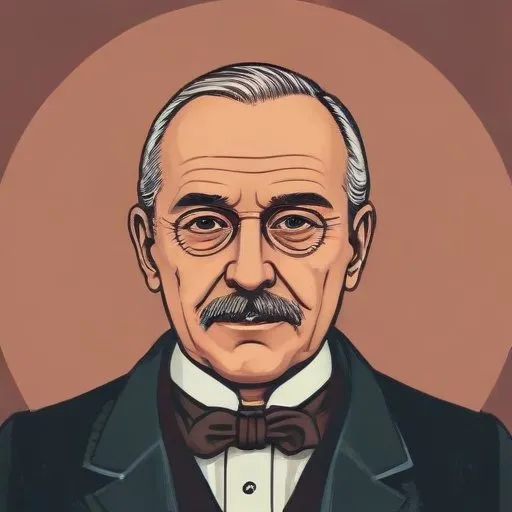
Developed methods for producing sulfuric acid and nitric acid on a large scale, revolutionizing the chemical industry. Known for his work on explosives and fertilizers.
Wilhelm Steinkopf, a renowned German chemist, is infamously known for his groundbreaking work on the production of mustard gas during World War I. This deadly chemical weapon, codenamed LOST (LOmmelSTeinkopf), would go on to claim thousands of lives, leaving an indelible mark on the face of warfare.
Born on June 28, 1879, in Stafurt, Prussian Province of Saxony, Steinkopf was the son of Gustav Friedrich Steinkopf, a merchant, and his wife Elise Steinkopf née Heine. He began his academic pursuits in chemistry and physics at the University of Heidelberg in 1898, later transferring to the Technische Hochschule Karlsruhe (now Karlsruhe Institute of Technology) in 1899. It was during this period that he crossed paths with his future colleagues, Fritz Haber and Roland Scholl.
After completing his studies with a degree as Diplom-Ingenieur in 1905, Steinkopf worked as an associate professor at the Technische Universität Karlsruhe until 1914. When World War I broke out, he volunteered for service and was soon recruited by Fritz Haber, then director of the Kaiser Wilhelm Institute for Physical Chemistry and Electrochemistry, to head a team focused on researching chemical weapons.
In collaboration with chemical engineer Wilhelm Lommel, Steinkopf developed a method for the large-scale production of bis(2-chloroethyl) sulfide, commonly known as mustard gas. This lethal substance would go on to be used in various battlefields, leaving a trail of death and destruction in its wake. The German military would later assign the acronym LOST to this deadly concoction, a moniker that would forever be linked to Steinkopf's name.
As the war raged on, Steinkopf's work on mustard gas and related substances took a toll on his health. In 1917, he transferred to another department within the Kaiser Wilhelm Institute, overseeing the production of gas ammunition. After the war, Steinkopf relocated to Dresden, where he succeeded Reinhold von Walther as the associate professor in organic chemistry at the Technische Universität Dresden. He remained in this position until his retirement.
Steinkopf's work on mustard gas had far-reaching consequences, not only on the battlefields of World War I but also on the future of warfare. His research paved the way for the development of new, even more devastating chemical weapons. Today, Steinkopf's legacy serves as a stark reminder of the devastating power of science when wielded for destructive purposes.
Little is known about Steinkopf's personal life, aside from his academic and professional pursuits. He passed away on March 12, 1949, leaving behind a complex and controversial legacy that continues to spark debate among historians and scholars.
Wilhelm Steinkopf's story serves as a poignant reminder of the dual nature of science, capable of bringing about great progress and unspeakable destruction. As we delve into the complexities of his life and work, we are forced to confront the darker aspects of human ingenuity and the devastating consequences of playing with the very fabric of life.
Born in 1868
Developed a process to synthesize ammonia, revolutionizing agriculture and warfare, and was awarded the Nobel Prize in Chemistry in 1918.
Born in 1874
Developed the Haber-Bosch process, a method to produce ammonia on an industrial scale, revolutionizing fertilizer production and agriculture. This innovation had a profound impact on global food supply and population growth.
Born in 1835
German chemist and Nobel laureate who synthesized barbituric acid and developed the theory of organic dyes, revolutionizing the textile industry. His work laid the foundation for modern dye chemistry.
Born in 1847
A German chemist and academic who pioneered the field of alicyclic compounds and was awarded the Nobel Prize in Chemistry in 1910 for his work on alkaloids. He discovered and characterized many new compounds, significantly advancing the field of organic chemistry.
Born in 1872
A German-Swiss chemist and academic who discovered the structure of chlorophyll, the green pigment in plants, and was awarded the Nobel Prize in Chemistry in 1915. His work laid the foundation for modern plant biochemistry.
