


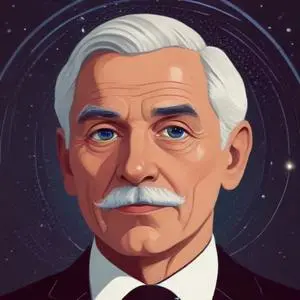
A pioneering astronomer and astrophysicist who deciphered the secrets of the universe's elements, earning a Nobel Prize for his groundbreaking work on nuclear reactions in stars.
William Alfred Fowler, an American nuclear physicist and astrophysicist, is renowned for his groundbreaking research on nuclear reactions within stars and the energy elements produced in the process, earning him the 1983 Nobel Prize in Physics alongside Subrahmanyan Chandrasekhar. His work, particularly the influential B2FH paper, has had a profound impact on our understanding of the universe and the creation of elements within stars.
Born on August 9, 1911, in Pittsburgh, Pennsylvania, Fowler grew up in Lima, Ohio, where his family moved when he was just two years old. His fascination with locomotives, sparked by his proximity to the Pennsylvania Railroad yard, would later translate into a passion for understanding the powerhouses of the universe – stars.
Fowler graduated from Ohio State University in 1933 and went on to earn his Ph.D. in nuclear physics from the California Institute of Technology (Caltech) in 1936. His academic achievements paved the way for a distinguished career in science.
Fowler's research career began as a research fellow at Caltech in 1936, where he would eventually become a professor in 1945. He was elected to the United States National Academy of Sciences in 1938, a testament to his early accomplishments in the field.
In 1957, Fowler collaborated with Margaret and Geoffrey Burbidge, as well as Fred Hoyle, on the seminal paper "Synthesis of the Elements in Stars" – better known as the B2FH paper. This work categorized most nuclear processes responsible for the origin of all but the lightest chemical elements in stars, revolutionizing the field of astrophysics.
Fowler's contributions to science were recognized with numerous awards and honors, including:
Fowler's work embodied a deep understanding of the interconnectedness of science and humanity. He believed that scientific inquiry should be driven by curiosity and a passion for understanding the world around us, rather than purely by practical applications.
Fowler's research has far-reaching implications for our understanding of the universe and the mysteries of element creation. His work has inspired generations of scientists and continues to shape our understanding of the cosmos.
In 1973, Fowler traveled to the Soviet Union to observe the steam engine that powered the Trans-Siberian Railway, a testament to his lifelong fascination with locomotives.
Fowler was a member of the Tau Kappa Epsilon fraternity during his time at Ohio State University.
In conclusion, William Alfred Fowler's groundbreaking work on stellar nucleosynthesis has left an indelible mark on the scientific community. His legacy continues to inspire new generations of scientists and astrophysicists, ensuring that the mysteries of the universe remain a compelling and fascinating area of study.
Born in 1910
A renowned scientist who pioneered our understanding of black holes and the behavior of stars, earning a Nobel Prize in Physics in 1983.
Born in 1882
A pioneer in astrophysics, he formulated the Eddington limit, a crucial concept in understanding stars, and was a key figure in popularizing Einstein's theory of relativity. His work bridged the gap between theory and observation in astronomy.
Born in 1915
A renowned astronomer and science fiction author who proposed the steady state theory of the universe and coined the term "Big Bang", making significant contributions to our understanding of the cosmos.
Born in 1918
A pioneering radio astronomer who made groundbreaking discoveries about the universe, including the detection of quasars and the mapping of the cosmic microwave background radiation.
98 Years Old
Pioneering astronomer who confirmed the existence of dark matter, revolutionizing our understanding of the universe. Her groundbreaking research transformed the field of astrophysics.
84 Years Old
A brilliant mind who unraveled the mysteries of black holes and the universe, making complex physics accessible to all through bestselling books.
92 Years Old
A renowned space expert who explored the universe, searching for life beyond Earth and explaining complex science in simple terms.
68 Years Old
Astrophysicist and science communicator who makes complex concepts accessible to the masses through engaging writing and hosting popular TV shows. He's a leading voice in promoting science education and critical thinking.
