


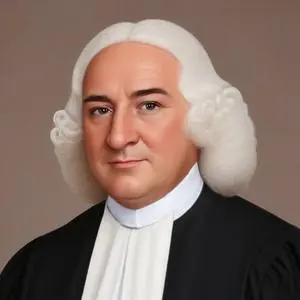
A renowned English lawyer, judge, and politician who wrote extensively on English law, shaping the country's legal system and influencing many other jurisdictions. His works remain a cornerstone of legal education.
William Blackstone is renowned for his magnum opus, Commentaries on the Laws of England, a comprehensive treatise that systematized English common law, cementing his position as a leading authority on the subject. This seminal work, comprising four volumes, not only revolutionized the understanding of English law but also earned him a staggering £14,000 (approximately £2,459,000 in 2023 terms) in royalties.
Born on July 10, 1723, in London, Blackstone was the son of a middle-class family. He received his education at Charterhouse School before matriculating at Pembroke College, Oxford, in 1738. After completing his Bachelor of Civil Law degree, he was elected a fellow of All Souls College, Oxford, in 1743.
Admitted to Middle Temple in 1746, Blackstone was called to the Bar, marking the beginning of his legal career. Initially, his practice as a barrister progressed slowly, but he soon found himself drawn to university administration. He became accountant, treasurer, and bursar at All Souls College, Oxford, in 1746, and later, Senior Bursar in 1750.
In 1753, Blackstone abandoned his practice as a barrister to focus on a series of lectures on English law, thereby establishing himself as a trailblazer in the field. These lectures, the first of their kind, earned him a substantial sum of £453 (approximately £89,000 in 2023 terms). This success led to the publication of An Analysis of the Laws of England in 1756, which repeatedly sold out and was used to preface his later works.
In 1759, Blackstone was appointed as the first Vinerian Professor of English Law, further solidifying his reputation as a leading authority on English law. He published A Discourse on the Study of the Law, a treatise that reinforced his growing fame.
Blackstone's contributions to English law have had a profound impact on the development of the legal system. His work not only codified English common law but also influenced the evolution of law in other nations, including the United States. Today, Blackstone's Commentaries remain a cornerstone of legal education, a testament to his enduring legacy.
Blackstone's work has permeated modern society, shaping the very fabric of our legal systems. His emphasis on the rule of law, individual rights, and the importance of a fair and impartial judiciary has left an indelible mark on contemporary legal thought.
William Blackstone's remarkable life and achievements have left an enduring legacy, cementing his position as a towering figure in the history of English law. His groundbreaking work continues to inspire generations of legal scholars, jurists, and thinkers, ensuring that his impact will be felt for centuries to come.
Born in 1552
A prominent figure in English law, he played a significant role in shaping the country's legal system and is remembered for his contributions to the development of common law.
Born in 1561
A 16th-17th century Renaissance figure who pioneered the scientific method and empiricism, and served as a prominent government official.
Born in 1632
A 17th-century thinker who laid the groundwork for modern democracy, arguing that governments derive their power from the people and that individuals have inherent rights to life, liberty, and property.
Born in 1588
A 17th-century philosopher who introduced the concept of social contract, arguing that people voluntarily give up some rights to a sovereign power in exchange for protection and stability. His ideas shaped modern political thought and the nature of government.
Born in 1676
The first Prime Minister of the United Kingdom, serving from 1721 to 1742, known for establishing the office of Prime Minister and setting important precedents for the role. He is also recognized for his skill in managing Parliament and his role in shaping British politics.
Born in 1749
A prominent 18th-century politician who championed individual liberties and opposed British imperialism, known for his charismatic oratory skills and influential foreign policy decisions.
Born in 1759
A British abolitionist who led the movement to end the slave trade in the UK, playing a key role in passing the Slave Trade Act of 1807.
Born in 1846
A Nigerian priest and historian who wrote the first comprehensive history of the Yoruba people, providing valuable insights into their culture and traditions.
