


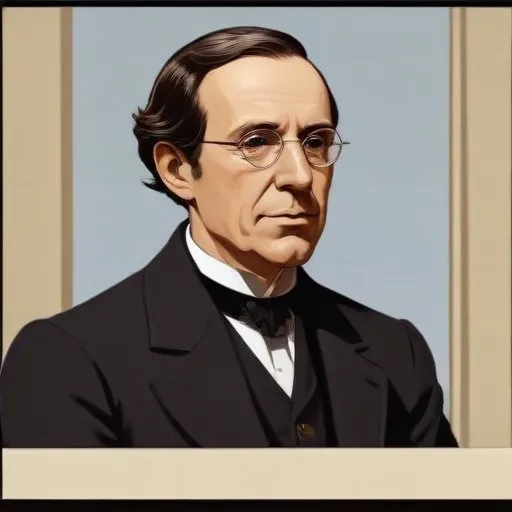
A prominent 19th-century minister, historian, and author who wrote extensively on American church history, particularly the Congregational Church. His works remain valuable resources for historians today.
William Buell Sprague is renowned for his magnum opus, the Annals of the American Pulpit, a nine-volume biographical dictionary of leading American Protestant Christian ministers who died before 1850. This exhaustive work, published between 1857 and 1869, has become an indispensable resource for historians and scholars of American religious history.
Born on October 16, 1795, in Andover, Connecticut, Sprague was educated at Yale under the influential Timothy Dwight IV, graduating in 1815. He subsequently studied at Princeton Theological Seminary under Dr. Archibald Alexander and Samuel Miller, laying the foundation for his future ministerial and literary pursuits.
In 1819, Sprague became assistant to the Rev. Joseph Lathrop at the West Springfield, Massachusetts, Congregational church. Upon Lathrop's death, Sprague succeeded him as senior minister, serving in that capacity for nine years. He later accepted a call to pastor the Second Presbyterian Church, Albany, New York, where he ministered for an impressive forty years.
Sprague's literary output was remarkable, with numerous books and pamphlets to his credit. His notable works include Lives of the Rev. Edward Dorr Griffin, D.D. (1838), Timothy Dwight (1845), and The Rev. Jedidiah Morse (1874). His individual sermons, discourses, and addresses in pamphlet form exceeded 150 in number.
Sprague was also an avid collector of historical documents and pamphlets. He achieved a remarkable feat by becoming the first person to gather a complete set of autographs of the signers of the United States Declaration of Independence, completing this task by February 1833. Additionally, he collected the signatures of all the members of the Convention that framed the United States Constitution in 1787.
William Buell Sprague's Annals of the American Pulpit remains an invaluable resource for scholars, providing insights into the lives and contributions of prominent American Protestant ministers. His dedication to preserving the history of American Christianity has left an indelible mark on the religious landscape of the United States.
Sprague's remarkable life, spanning over eight decades, came to a close on May 7, 1876, in Flushing, New York. His commitment to his faith, his scholarship, and his passion for preserving history continue to inspire future generations of scholars, ministers, and individuals interested in American religious history.
Through his life's work, William Buell Sprague has left an enduring legacy, illuminating the lives and contributions of American Protestant ministers and cementing his own place in the annals of American religious history.
Born in 1813
A prominent abolitionist and women's suffrage advocate, known for his powerful oratory skills and influential writings that helped shape public opinion on social issues.
Born in 1811
Wrote influential abolitionist novels, including "Uncle Tom's Cabin", which humanized the horrors of slavery and fueled the anti-slavery movement.
Born in 1800
Pioneering educator and women's rights advocate who championed equal access to education and advocated for women's roles in society. Known for her influential writings on education and domesticity.
Born in 1799
A British naval officer, hydrographer, and explorer who mapped many previously unknown coastlines and islands, particularly in the Pacific and Arctic regions.
