


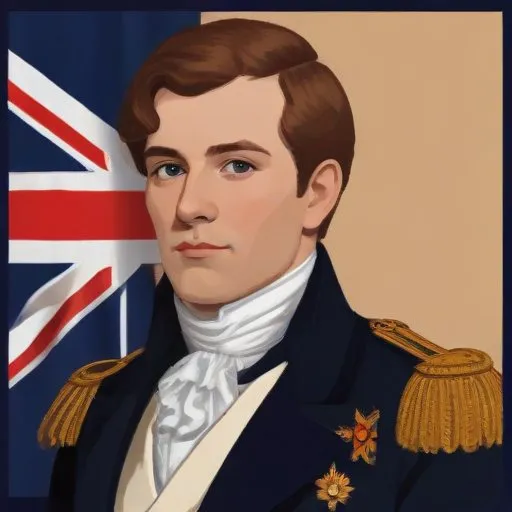
A British naval officer and politician who fought in the American Revolutionary War and later served as a Member of Parliament, known for his bravery and aristocratic lineage.
William Byron, 5th Baron Byron, is remembered as a British nobleman, politician, and distant relative of the famous poet George Gordon Byron. However, his own life was marred by controversy, financial difficulties, and a reputation that earned him the nickname "the Wicked Lord" and "the Devil Byron."
Byron was born on November 5, 1722, to William Byron, 4th Baron Byron, and his wife, the Hon. Frances Berkeley. His early life was marked by a mix of privilege and turmoil. At the age of 14, he enlisted in the Royal Navy as a midshipman and later served as a lieutenant on HMS Victory at 18. Simultaneously, he was listed as a founding Governor of the Foundling Hospital, a charitable organization that cared for abandoned babies.
On March 28, 1747, Byron married Elizabeth Shaw, daughter and heiress of Charles Shaw of Besthorpe in Norfolk. The couple had four children, two of whom survived to adulthood. However, Byron's financial difficulties began to mount, and he struggled to manage his estate. These troubles would haunt him for the rest of his life.
Byron's involvement in Freemasonry was significant, as he was initiated into the Scottish Rite Masonry and became the Grand Master of the Grand Lodge of England Moderns from 1747 to 1751. He also held the position of Grand Master of the Premier Grand Lodge of England from 1747 to 1752. However, it was a duel with his distant cousin, William Chaworth, on January 26, 1765, that would cement his notorious reputation. The duel, which resulted in Chaworth's death, further solidified Byron's reputation as a hot-headed and reckless individual.
William Byron, 5th Baron Byron, died on May 19, 1798, leaving behind a legacy of controversy and financial struggles. His great-nephew, George Gordon Byron, would go on to become a celebrated poet, but William's own life was marked by turmoil and infamy. He remains a fascinating, if troubled, figure in British history.
Born in 1792
Romantic-era writer of lyrical poetry and Gothic dramas that explored the human condition, freedom, and the beauty of nature.
Born in 1797
Author of Gothic novels, particularly the iconic "Frankenstein", which has become a cultural phenomenon and influenced countless adaptations and reinterpretations.
Born in 1788
Romantic poet and playwright celebrated for passionate, expressive works that explored themes of love, freedom, and the human condition.
Born in 1795
Physician and author who wrote the influential short story "The Vampyre," considered the first modern vampire tale, inspiring countless adaptations and reimaginings.
Born in 1815
Pioneering mathematician and computer scientist who wrote the first algorithm intended to be processed by a machine, and is often considered the first computer programmer. Her work on Charles Babbage's Analytical Engine envisioned its potential to go beyond mere calculation and perform any task that could be expressed in a series of steps.
