


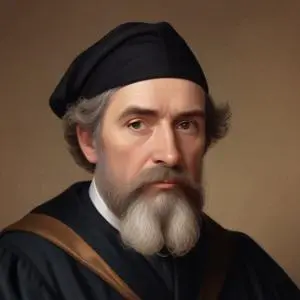
A 16th-century English physician, physicist, and astronomer who pioneered the study of magnetism and electricity, and is credited with coining the term "electricity".
William Gilbert, a renowned English physician and scientist, is best known for coining the term "electricity" and publishing the first comprehensive treatise on the subject, establishing him as the father of electrical engineering. Born on May 24, 1544, in Colchester, England, Gilbert's pioneering work laid the foundation for modern electrical research.
Gilbert was born into a family of modest means, but his academic brilliance earned him a scholarship to St. John's College, Cambridge, where he studied medicine and philosophy. He later moved to London, becoming a prominent physician and gaining the attention of Queen Elizabeth I, who appointed him as her royal physician in 1601.
Gilbert's most notable contribution was his publication of De Magnete, a seminal work that introduced the concept of electricity as a distinct form of energy. In this treatise, Gilbert described his experiments with magnetism and electricity, demonstrating that they were separate phenomena and proposing the concept of the "electric atmosphere."
Gilbert's work was not only a scientific milestone but also reflected his philosophical views on the nature of the universe. He believed in the concept of a universal force, which he termed "
Gilbert's work had a profound impact on the development of modern science and technology. His discovery of the properties of magnetism and electricity paved the way for the creation of electrical devices, from generators to motors, and enabled the development of modern electrical power systems.
Gilbert's work was often compared to that of his contemporaries, including Galileo Galilei and Johannes Kepler. While they focused on celestial mechanics and astronomy, Gilbert's pioneering work in electricity and magnetism marked a significant departure from the traditional Aristotelian views of the natural world.
Gilbert's personal life was marked by tragedy, with the loss of his brother, who died in 1583. This event led Gilbert to dedicate himself to his scientific pursuits, culminating in the publication of De Magnete.
Gilbert's pioneering work in electricity and magnetism established him as a foundational figure in the history of science. His legacy extends beyond his scientific contributions, as he helped shape the intellectual landscape of the Renaissance and paved the way for modern scientific inquiry.
Gilbert's impact on electrical engineering is evident in the numerous honors and awards bestowed upon him. The Gilbert unit, a measure of magnetomotive force, is named in his honor, and his work continues to inspire scientific innovation and discovery.
Today, William Gilbert is remembered as a trailblazer who challenged traditional views and pushed the boundaries of human knowledge. His groundbreaking work in electricity and magnetism has left an indelible mark on the history of science, cementing his place as one of the most influential scientists of the Renaissance.
Born in 1564
Pioneering astronomer, physicist, and mathematician who played a major role in the Scientific Revolution, making key discoveries that challenged Aristotelian views and laid the foundation for modern science.
Born in 1571
A 17th-century trailblazer who discovered the three laws of planetary motion, revolutionizing our understanding of the solar system. He's also credited with being a pioneer in the field of astrology.
Born in 1546
A 16th-century astronomer who made precise measurements of the stars and planets, laying the foundation for modern astronomy. His data helped Kepler discover planetary orbits.
Born in 1473
A Renaissance-era mathematician and astronomer who proposed the heliocentric model, where the Sun is at the center of our solar system, revolutionizing our understanding of the universe.
Born in 1561
A 16th-17th century Renaissance figure who pioneered the scientific method and empiricism, and served as a prominent government official.
Born in 1596
Developed influential philosophical and mathematical concepts, including the famous phrase "I think, therefore I am," and laid the foundation for modern Western philosophy.
Born in 1656
Predicted celestial events, including the return of a comet that bears his name, and made significant contributions to navigation, astronomy, and mathematics.
